3/24/2016

Konmari - Category 2 - Books


After the euphoria of going through all of my clothes, getting rid of so many, and finally knowing where everything was, in my head I thought I would move on to the next Konmari category right away.  Just like the Marie Kondo's book says, you have to really dedicate yourself to the process, and do the whole thing all at once.  I was and am dedicated.  I really want to do this!  But reality intruded in the form of a bunch of gigs and weekends away.  I didn't get to the next category - books - until about a month later, in late-February.

As with my clothes, I thought that books wouldn't be too hard.  They are so solid and finite and mostly in one room in my house, right?  Not so.  There were books in just about every room on the 1st and 2nd floors of the house.  Even gathering them all together, and lugging them up stairs to my sorting area took a lot of time and work.  But eventually, they were all there and covered so much of the available space in the room, that it was hard to find a spot for me to first divide them into "stay" and "go" piles, and then to sort them by category for re-shelving.


Books are the second category in Marie Kondo's tidying scheme because, in theory, they are relatively easy to sort and part with.  And while it's true that many books are available electronically, 1) books are wonderful, and not easy to part with, and, 2) art books, and any non-fiction books with pictures are just not the same in electronic format.  Guess what I have a lot of?  In fact - true confessions time - there was one whole category of books I didn't bother to move off of their shelves and into my sorting area because I knew that none of them were going - my tea books.


This photo shows only half of my collection, and doesn't include the additions that were in the big pile in the other room because they hadn't made it to the tea shelves yet.

But over a couple of days, I just attacked one pile of books at a time, and filled at least 10 bags to give away.  And then over a few more days, I sorted all that was left by category and re-shelved everything, discovering that I really did have more room on my shelves than before.

Here are some of my take-aways:
  1. It ain't over 'til it's over.  Kondo says in her book that once you're done with clothes and move on to the other categories, you can't really be finished with the organization process until you do all of the other things.  I now get it.  I had other things on my bookshelves like video tapes, candles, etc.  When I was re-shelving the books and thinking about the space I had available, I hadn't dealt with those other non-book items yet, and so knew that I might have to move the books again once more space became available.  My next post will talk about that a little more.
  2. For me, the definition of "doing everything all at once" is going to end up being one category a month.  I hate the feeling of drawing out this process indefinitely and really want to live in a saner environment right now, but my life is so busy with many weeknights and weekends taken up by travel or other activities I'm not willing to give up.  So my reality is that this process is going to take at least the rest of the year.  I hate even writing that down, but welcome to my life.
  3. Giving things away is hard!  Once I decided to let a book go, it wasn't actually hard to part with it.  What was difficult was figuring out how to dispose of them.  I knew I could take the books to Goodwill, which has a very convenient drop-off near my house, but I thought to give them to the Free Library Book Corner, which could re-sell them and make some money for the Free Library, of which I'm a big fan.  Unfortunately, for what I'm sure they think are good reasons, they make it really hard to donate books to them (and had a rude, impatient person answering the phone, which was decidedly off-putting), so that was out.  Then I found an organization which has book donation boxes scattered throughout the area, but when I loaded all of the bags of books into the car and found the local box, it was stuffed so full, I couldn't add a thing to it.  Luckily, there was a Green Drop truck in the same location that was happy to take my books.
  4. Going through each category will have an emotional component to it.  It's always work to stay away from the the feelings of guilt/regret/self-recrimination for amassing so much of whatever it is, but that's not helpful, and I'm dealing with it right now, so no wallowing allowed.  But the other piece is that if you're a person who likes things, the way I do, facing that crazy pile is a bit overwhelming, and letting go of objects is hard, even if you're committed to the process and know why you're doing it, how to do it, etc.  It's just a lot.  It's worth it, but I have to remember that each time I work on this project will take both physical and emotional energy.
Stay tuned for the next exciting installment:  media...

1/25/2016

KonMari - Category 1 - Clothes

It has begun!

This weekend I began my project based on Marie Kondo's book, The Life-changing Magic of Tidying Up.  My goal was to get through at least one category - amassing all of the stuff in one location in the house, going through it item-by-item, touching each thing, keeping everything that "sparked joy," discarding the rest, and finally figuring out how to organize it all, and put it all away.

This past week I worked on a project spreadsheet to keep me organized.  Each tab of my spreadsheet is a category of items containing a list of the things in that category.  My categories are specific to my belongings, but they follow Kondo's order and guidelines of clothes, then books, papers, other stuff, and sentimental items.  This weekend, the task was clothes.

My goal for this project is to follow Kondo's methods as closely as possible.  I outlined those in my previous post.  One key thing I did differently was not work on the project alone, but with my husband.  To make this even possible, before we got to work we talked about what was going to happen, why the process is about one person making decisions about his or her belongings, and what his role in would be.
  1. He would not offer opinions, and I would try to not ask for his opinion, but decide for myself if something stayed or went, how to arrange the drawers and closets, etc.  
  2. He was not there to make the process harder by making suggestions of how I should get rid of things, unless I asked him.  No, "oh you should try and give this to so and so."  No.  That just piles more work on me and makes me cranky.  If I give things away, though in a perfect world, I want them to go to just the right person or charity, chiefly, I want that part to be easy and I want the stuff out as fast as possible.   
  3. He was there to support me by doing what I asked.  When he goes through his things, I will do the same for him.  
Except for some lapses on both of our parts, this worked pretty well.  He fetched and carried and gave me hugs and encouragement at regular intervals.
 
So, clothes.  I thought about the clothes I have, and where they were in the house, and naively assumed that going through them all would take a couple of hours, max.  Then we began pulling all of them out of closets, drawers, shelves and bins and piled them all in the front room.  Just that part of the process daunting and tiring.  I didn't want to stop working, but I was taken aback at the size of my wardrobe.  I know where it all came from.  It's the product of 20 years, with only sporadic weeding.  But seeing it all together like that was a little alarming.  Below are 4 of the 7 closets that held my clothes, and part of my shoe collection (note:  a bunch of those shoes are not mine, but you get the idea...) just to give you a taste of what we were up against.

3rd Floor Side guest room
Ball Gown closet


Office wardrobe
Craft Room closet
 
Shoes in the entryway

When we piled everything up, here's what it looked like.  It was crazy.


I hardly knew where to begin.  I needed to work on something discrete and manageable. That turned out to be shoes.  I looked at them all.  I touched them all. I didn't even realize that I had so many pairs of shoes.  I mean, I sort of knew, but not really.  In the end, I got rid of 14 pairs and kept 13, including 3 pairs of dance shoes.

Saying goodbye to my beloved bunny slippers...

Next I was ready to tackle socks and underwear.  It turned out that I had 14 pairs of brand new stripey socks in a plastic bin in my craft room!  The perfect place to forget about them!  Staying true to Kondo's method, we took the tags off of them put them in with all of the rest of the items so I can't continue putting off wearing new items just because they are new.  This was also my first opportunity to try out Kondo's folding techniques.  Sure enough, not only did all of the socks and underwear I was keeping, including the new socks, fit into one dresser drawer, so did my bathing suit and the undergarments I have for formal dresses, which were always hiding elsewhere.  Here's a before and after: 

Sock drawer - before...
...and after

Shirts were next.  I did refold all of them, and sort them partly by color and partly by use.  I will try and keep them this way.  I love the amount of space in my re-done drawer.  I breathe better every time I see it.

Before...

...after
I went on to do pants, work tops, bottoms and dresses, scarves, formal dresses, dance clothes, hats, jewelry, tights/stockings, sweaters, coats, and bags.  In the end I amassed 8 contractor bags of clothes for charity, 3 bags of clothes and accessories for my dance group to pick through, at least 3 bags of trash, some specific items for specific people, and, many thousands of the item that must grow in my house, hangers!  Because I was getting rid of so much hanging stuff, I took the opportunity to change as many of the hangers as possible to the ones I like and get rid of the rest.  My very patient husband not only helped me with this, but bundled up all of the like hangers in hopes they will be useful to some thrift store.


At the end of the day on Saturday, when I was finished going through all of the clothes, but not some of the other stuff, I didn't have a great sense of calm or relief.  I felt mixed - pleased that I had done so much, unsure if I had gotten rid of enough, and really unsure that I had truly used the "spark joy" methodology in keeping what I did.  Also, although the dresser drawers were in place, the rest of the clothes were all jumbled up in the wrong closets.  All of this was unsettling.

On Sunday the first thing I did was reorganize all of the closets - re-hanger everything, and take another look at all of it.  I am now only occupying 4 closets!  I only have to remember where things ended up!  Here are two closet "after" shots.


By mid-afternoon on Sunday, I had gone through everything in the clothes category, and I felt great about it.  Nothing is hiding in a bag on a closet shelf where I forget about it.  All of my jewelry is in one place that makes sense to me.  My closet choices take into account where the cat likes to hide and shed all over my long dresses.  Everything has a place!  I'm excited!  My mixed feelings from Saturday were gone, which was a relief.

I didn't do everything the KonMari way.  Two things in particular:  I didn't arrange the items in a given closet by color, but instead grouped things by type.  Almost everything is black, purple, or red to begin with, so arranging from light to dark is kind of a non-starter for me.  Also, I didn't automatically assume that "maybe" means it has to go.  There are things that I really do like, and wanted to keep and commit to wearing that I forgot I had.  If I wear them and decide I don't like how they look any more, I'll get rid of them then.

I feel like I now have a better sense of my wardrobe and finite choices about what to wear.  This really just makes my like easier.  And I love that feeling of not discovering a pair of earrings in a drawer that I love and have forgotten about, or dislike, but yet trip over every time I'm looking for something else and find them taking up drawer space.  The key will be to see if I can keep up this organization system, and keep things tidy, not add things unless I'm filling a particular gap, and commit to using new things right away.  Overall, I feel more mindful about my clothes, and not over-burdened by that pile I had at the beginning.  As soon as I can get to the thrift shop and get rid of all of the discards, it will be even better.

I am eager to move on to the next category:  books.  I have part of next weekend to do this, but after that, weekends are a bit scarce, so I envision my tidy-everything-in-the-whole-house-all-at-once will easily expand to fill at least the next 6 months!

1/20/2016

Tea party readiness...

Okay, this post has very little to do with tea...

A couple of weekends ago, I hosted my first tea party of the year.  It wasn't really an on-purpose tea party, but a get-together in the guise of a meeting that just happened to occur at teatime.  I needed no more of an excuse to make tea sandwiches and cinnamon chip scones for three.

I love having people over and tea parties and hosting parties in general, and, in fact, any excuse to use all of my tea and entertaining things, of which I seem to have quite a bit.  But other than not having enough time to do it, which is always true, there are a couple of things that make having people over more of a challenge for me:

1)  My house is not in good enough shape.  I know, I know, most people, and friends in particular don't care what your house looks like (except for the ones that do).  But I care.  In my dreams, my house would be neat and clutter-free, which makes cleaning easier in the first place, so that when someone is coming over, it would only require a quick going over to be my standard of ready.  Instead, I either depend on my friends not noticing  (or not saying anything, or not being visibly uncomfortable) or go through a cleaning frenzy which is effective, but exhausting, before I even get to the fun part of making food or setting the table.

2)  I have so many serving pieces, tea pots, sets of china, napkin rings, and on, and on, carefully stored away that I don't remember what I have, where it is, and so don't remember to use it.  Or, I have things I consider to be "good" that go untouched, just as my mother and my grandmother before me never used them ever.

This jumble of thoughts coincided with a book coming to the top of my Hold list at the library that I'd been eager to read for some time:  the best selling book by Japanese author and de-cluttering expert Marie Kondo, The Life-changing Magic of Tidying Up.  

If you look on the internet you'll find that people have feelings about this book.  Some have found it transformational, some think it's nonsense, and every opinion in-between.  On a first read, I think it provides a good framework for a task I've been wanting to do anyway.  Here are some of the key points (with some of my opinions sprinkled in):

-Be committed to tidying.  Have a reason why you want to have a tidy house and keep it that way, whether you more time in your life to do other things other than de-cluttering all the time, or you need the mental energy for something else.  Whatever it is, know what it is and why you are doing this.
-Tidy the whole house all at once, not piecemeal, not for an hour at a time, but as an on-going, marathon project until you are done.
-De-clutter by category, not by room - you don't know where duplicates are hiding until you see them all together, and if you tidy by room, chances are you are mainly moving things around, instead of truly sorting through them, and then finding a permanent home for the things you are keeping
-Discard first, and then find storage for everything.  Most likely you already have more than enough bookcases, plastic bins, etc.

-Tidy in the right order:  clothes, books, miscellany, and sentimental items.  You can create sub-categories for each of these broad categories, but follow this order which takes you from the easiest to the hardest things to deal with.
-Keep the things that "spark joy."  That phrase is a bit much for me, but my take on it is a non-judgmental one:  Keep the things you love.  Get rid of the rest.  Don't fall prey to the idea that you'll use it or wear it someday.  Likely you won't.  If you need to have multiples of things, fine, but be purposeful about it, not random.  Kondo wants you to actually pile up all of the things in one category in one place, and pick up each item to help you decide whether or not to keep it.
-It's not only beautiful things that can spark joy.  You may choose to keep things that make your life easier, have a high degree of functionality, or are useful everyday.  Be reasonable - household cleaning products are not going to spark joy, but you still need them.
-Tidying and cleaning are different things.  Tidying has to do with objects; cleaning has to do with dirt. 
-Don't keep things because someone else wants you to, because they had sentimental value at one kind, or out of obligation because someone gave it to you.  Instead, appreciate the moment of acquisition, or the sentiment behind the gift, or the generosity of the giver, and let the item go.
-Tidying is an opportunity to assess your current preferences and tastes.  Focus not on getting rid of things, but instead on keeping only things that you love, use, and want near you.
-Don't tidy/discard things that are not yours - that's rude.  Don't let others sway you to keep things you can let go of because they might want them, or for other sentimental reasons.

So, the project begins this weekend - perfect for the predicted snow accumulation.  As Kondo demands, I'll start with my clothes, including my shoes, which I have scattered in closets, bins, and drawers all over the house (I just remembered that I have two pairs of shoes at the office.  Home they come).

I'll use this space to document my progress.  I expect it to take the better part of the year.  But when it's all done, I hope to have more time and more head space to work on crafts, write tea book reviews, and have you all over for a party...

12/14/2015

Checking back in...

Hmmmm...  Last post on April 1st...  As spring turned into summer, then fall, and now, almost winter, time and tea books got away from me.  I actually took several tea books away with me on vacation at the end of May, and wrote notes about 2-1/2 of them.  The notes are still sitting in my notebook, as yet unpublished.  But as of this weekend, it feels as if my major obligations for the year are finished (okay, that's not really true, but it feels true), so here we go again with another attempt...

(Of course, part of the time crunch is my second blog, Joanna Creates, which I'm using to capture my forays into arts and crafts.  I have updated there somewhat in the interim...)

One thing I've done a little of recently, despite telling myself I wouldn't, is buy magazines.  I don't have many - probably half a dozen assorted issues purchased at the bookstore waiting to be read, and another half dozen from a short-loved subscription to Martha Stewart Living.  In the first stack are two issues of Tea Time, which I think used to be called Southern Lady Tea Time after its parent publication.  It says on the cover that it it the winner of the Best Tea Publication.  I could be wrong, but it's certainly the only tea publication I've seen recently on the shelves at Barnes and Noble...  I have this year's September/October issue and November/December issue.  I'll review each separately as a way of easing back into book reviews.


The editor's letter of the September/October 2015 issue of Tea Time promises that that magazine will be full of "autumnal inspirations."  This is borne out in various articles including the tablescape piece and the themed tea parties.  The tablescape article talks about using one china pattern, "Autumn," by Lenox, in different ways for an elegant or more casual look by pairing it with various other china patterns, tablecloths or placemats, crystal, and other decorations.  This article isn't specifically tea-themed, but applicable to tea parties and the vibe of the magazine in general.

Tea Time has three themed teas:  Apple, Grandparent's Day, and Harvest Moon.  Each tea party has recipes and recommended tea pairings.  It's easy to connect apples with autumn and understand how the recipes and the tablescape for the party fit the theme.  Apparently Grandparent's Day happens in September or October, but it seems to be just a good excuse for a party as the recipes and decor have no real connection to the theme.  It might have been nice for this one to have some activities one might do in observance of this made-up holiday involving photos or family trees or something like that.  The last tea in honor of the harvest moon features the table setting from the magazine's cover and does include decor suggestions relating to the theme.  The recipes for this one seem more in harmony with the color scheme and china pattern than with the actual harvest.  One note about the tea pairings:  they all seem to be suggestions based on the magazine's advertisers, and not necessarily the best tea for each course drawn from a large, objective list.

Tea Time always reviews tea rooms.  Often tea rooms in one particular US state are featured.  This issue covers New Jersey, and a tea room outside of London.  The eight NJ tea rooms featured all seem to have opened in the last 10-15 years, or more recently.  I wonder if this is an inadvertent comment about the likelihood of tea room longevity, if there are older, more established tea rooms out there, and if those in the article will still be there by the time I get to visit these tea time destinations in my neighboring state. 

One of my favorite features of Tea Time is its articles about tea tools:  teapots, cups, furniture, etc.  This issue covers the gaiwan cup and the Brown Betty teapot in seperate articles.  I've been hearing more and more about gaiwan cups as I read more books and blogs written by true tea afficianadoes (as opposed to those more focused on tea as an occasion).  I think I understand how to use a gaiwan, but the article was only a glimpse, and not an instruction guide.  I'll call the article a success as it made me want to learn more.  We use a Brown Betty as our daily, go-to teapot, and that article made me want to check the bottom of the pot to see if it's the genuine article...

In general, Tea Time's content is purposefully light.  It caters to the tea party set, which I count myself a part of, not those in the industry and a part of the global, non-white world of tea and tea drinking.  It has articles by three mainstream luminaries:  James Norwood Pratt, Jane Pettigrew and Bruce Richardson.  Its resource lists, which I'm glad exist on general principles, cover china patterns and their prices and recipes, and not bibliographic information.

It'll be interesting to read the November/December issue in quick succession with Sept/Oct, and see what's the same, what's different, and how this magazine reflects a certain part of the US tea-drinking world.

4/01/2015

Two quick things...

1.  Because I obviously have too much time on my hands, I just started a second blog to talk about craft-related things and projects.  Take a look:  http://joannacreates.blogspot.com/

2.  Reviews of tea and entertaining books will continue in this space.  I may even veer off that fruitful topic every now and again and show you pictures of my garden or something.  But on the topic of tea book reviews, one of the blogs I read featured a weekly review of a tea book a year or so ago.  We have a bunch of books in common, and I'm not reading her reviews of the same book until after mine are done.  Fascinating to read the differences.  Guess who seems to be snarkier and more opinionated??  Check in out:  Tea With Friends

3/31/2015

Time for Tea

This week, I read Time for Tea; Tea and Conversation with Thirteen English Women by Michele Rivers, published in 1994.


This is another tea book I bought, sight unseen, and haven't gotten around to reading until now.  I was intrigued by the premise of the book.  It is neither a book about the tea table nor a recipe book, though it does include some recipes.  Rather is is simply a series of conversations with actual people to try and capture why the tea time ritual is important in their lives, if it is at all.  The idea is that tea in England is only rarely the lace cloth and best china kind of event.  Tea as an event, or simply a beverage come in all forms.  This book is a glimpse of some of them.

The women interviewed for the book vary:  a farmer, an artist, bed and breakfast owner, grocery store check-out person, a Lady, a Marchioness, a six-year old, etc.  None live in London; most seem to have children.

Each chapter begins with a description of the interviewee - a bit about her life, history, job, etc.  The heart of each chapter is the interview, which is presented as an essay by the subject.  Each story is different, but you can almost hear the author begin each interview in the same way: "tell me about tea time - what it is, and what it means to you."  The essay begins with tea, or touches on it in some way, but each chapter takes off from that point.  We learn about the features and the challenges of daily life, raising children, dealing with divorce, hectic schedules, animals and guests that need to be fed.  Many of the women have had big transitions in their lives - new careers, second husbands, etc.  For each woman though, it seems that tea plays a similar role in their lives, even if they don't perceive it in that way.  Tea time is a pause in the routine, whether it comes daily, weekly, or only occasionally.  It's not a grab-and-go beverage like coffee, but a moment to stop and reflect or stop and chat for a second, or simply take a brief break from the race.

The final interview with two teenagers sums things up well.  Even if the subjects don't think that tea is a part of their lives, it somehow is.  They all drink more tea than they think they do.

So what role does tea and tea time play in your life?

3/20/2015

The Pantry

This week I finally finished re-reading The Pantry:  Its History and Modern Uses, written by Catherine Seiberling Pond in 2007.


The Pantry covers the history of the room in American homes, and is meant to be an inspiration for modern pantries, which are one of most asked for spaces among house hunters.  The book is divided into chapters, each covering pantries of a different era.  The Early American chapter points out that pantries were a necessity because food storage was crucial as people bought (made, grew, etc.) food in quantity to last for long periods of time, especially those who lived outside of urban areas.  By the Victorian era, kitchens were more industrial with cast iron stoves and linoleum floors.  This was the era of home economics where the kitchen was meant to be hygenic and efficient.  Kitchens were work spaces, no longer the center of the home, but moved to the back, or even to the basement in urban homes.  In this era, especially in upper class homes, the butler's pantry became the buffer zone between the kitchen and the dining room.

When I think of a pantry, I have the image of a butler's pantry:  banks of cabinets with glass doors above and long counters, that combination of display and storage away from the grease and dust of the kitchen.  Something like this would do just fine:

I would love a built in butler's pantry taking up the whole wall! think of what you could hide within!!! could also do drawers instead of cabinets below

By the middle of the 20th century, food shortages during the wars and the birth of convenience foods and neighborhood grocery stores meant that there were fewer foods to store.  The space pantries took up was re-purposed for broom closets, breakfast nooks, etc.  The function of the pantry was subsumed into the kitchen.

But now (at least in 2007), the pantry is back.  With the DIY and maker movements, and people into growing and preserving food, they need a place to keep it all.  If you want to create a pantry reminiscent of any era, this book offers design hints at the end of each chapter to demonstrate what made pantries of that era unique. 

Do you have a pantry in your house?  I don't, and I desperately need one - for food and china storage.  To me the very word pantry conjures up the idea of order:  things displayed on shelves where they are easily located and accessed, beautiful things arrayed in the open where you can see them and remember you have them (and use them!) not hidden away and forgotten in a cabinet.  A pantry will definitely be something I look for in my next house!

2/23/2015

Shopping day!

Oh, my devoted fans, all two of you...  Another book review is in process and should appear some time this week.  But in the meantime, here's a preview of some new books just added to the collection.

I was in NYC yesterday, walking across town, wondering what happened to the Fishs Eddy store that used to be there (Note:  the Fish's Eddy store is still there, just at 19th and Broadway, not at 13th Street, where I was), when I spied the Strand Bookstore.  My friend George is always talking about the Strand, and his inability to leave the store without a bagful of books, but my memory of the Strand was of a series of kiosks by Central Park, not a stand-alone bookstore.  In I went.  Danger ahead.

The Strand is like a bookstore on steroids.  There are miles of books there, several floors, really high, really full shelves, new, used, everything.  I only scratched the surface as I had a train to catch,  but if you go, allocate a good bit of time.  And I will give you a list of things to look for for me.

The little time I had was spent in the cooking section.  Shock and surprise.  They have an area clearly labeled for books about tea and coffee, and another for entertaining.  Most bookstores have these areas as well, but they shrink every year until they are subsumed into "general cooking."  I came away with four books - three about tea, and one about table setting.  Stay tuned for reviews of these...


I'm surprised I don't have this book from the mid-80s by Michael Smith.  But my list says no.  I need to double-check.  If I have two, who wants the other copy?


Most of the tablescapes in this book are far too unrealistic and over-the-top for me, but I'm hoping to get some good ideas.


The couple that wrote this book have a few others published as well.  All of their books are really just recipe books from their bed-and-breakfast, but I always like seeing what recipes people choose for a themed tea party.  


Although it is unlikely I will ever make my own tea from homegrown plants, you never know...

What books are you reading this winter?


2/11/2015

Passion for Tea

I'd put this week's book on my Amazon wishlist a while ago.  The cover is so compelling...


And while I like nothing better than browsing for and buying books online, it will never beat being able to pick up a book, read the back or the flyleaf, and truly evaluate whether or not it gets into your collection.  So yes, I judged a book by its cover and failed...

Beverly Rorem's book from 2008 reminds me of nothing so much as a coloring book.  It shares those dimensions and soft-cover quality.  And while there are no pictures to apply my crayons to, the book might be improved by their inclusion.  But maybe I'm just too critical.

The author is clearly on a crusade.  She is not a tea expert (and not a writer), but a self-taught tea lover.  She opens the book saying that, "tea is sexy, tea is glamourous, tea is funky," but her examples don't demonstrate these ideas.  Just because there is a tea shop in the East Village doesn't mean that tea is funky.  The availability of more than one kind of tea at Caesar's Palace in Las Vegas does not make tea glamourous.  There's just no evidence in this book that tea is sexy at all.  But Rorem is certainly ardent, if not articulate.

The book jumps all over the place in terms of topics.  It reads like a grade school book report:  I've read a lot of stuff, now let me relate it all to you.  The author mentions Starbucks twice in the first ten pages and five times by page 40, as if mentioning a popular coffee establishment will lend tea and this book credibility.  She also tells you to read Wikipedia to research certain tea topics.  The bibliography credits several articles from the Encyclopedia Britannica as sources for the book.

The book concludes with a long chapter on all of the health benefits of drinking tea and includes snippets on how tea can cure anything from ADD to Alzheimer's, and everything in-between.

Passion for Tea, while clearly passionate, is a clear example of the perils of self-publishing.  In some ways I hope the author didn't have an editor, because this work does not do anyone credit.

But the cover is pretty!

1/21/2015

Table Settings; Special Touches for Entertaining

Finally, the last of my Victoria Magazine books.  I think...

This week I read Table Settings, published in 2002 by the Editors of Victoria Magazine, but largely written by Mary Forsell, a Victoria editor who wrote other books about entertaining, flower arranging and berries, topics near and dear to my heart.


The back cover of the book summarizes the contents well.  This book is about collecting, selecting and presenting tableware including china, silver, glassware, and linens.

The book is divided into chapters which inconsistently focus on dining occasions, dining locations, or tableware themes.  The first chapter covers breakfast time, which is often overlooked as a separate entertaining occasion but is often a part of weekend visits and other overnight stays.  I love the idea of this chapter, and often look for excuses to use my toast rack, but this chapter, like much of the book and the previous Victoria books is a great illustration of their issues with picture captions and sources.  The picture below (poorly photographed by me) features this great set of teacups with leaves - maidenhair fern, or maybe parsley leaves, or something like that.  I love those cups.  I would love to have them, or at least take a closer look at them.  But the book neglects to name their manufacturer (only the name of the photographer - at least that's something), and I can't find them on the web.  I think the picture caption thing is about this book being a compilation of Victoria material.  The pictures were likely take for long-ago articles, and who remembers what exactly was included in each image.  I suppose it's for the best, given the over-crowded state of my china cabinet, but I would make room!!!  If you have any ideas about who manufactured this pattern, let me know!


The next chapter focuses on dining alfresco.  Apparently, according to Victoria, at least in 2002, you need the excuse of the great outdoors to shed the formality of entertaining.  Outdoor table settings should be casual, colorful, and use everyday items in new ways.  A blanket can be used as a tablecloth, a washtub as a champagne cooler, etc.  I do love the idea of not worrying about finding a tablecloth that's long enough, but instead purchasing fabric right off the bolt and leaving the edges raw (it's outdoors, so raw edges are also allowed).

The next chapters focus on floral motifs and whiteware as a staple of entertaining, and later chapters cover using tablewares as art and display pieces, and various occasions or events for parties.  The "history" chapter strikes a chord as it focuses on the nineteenth century fashion of table services with huge numbers of very specific pieces.  This chapter articulated the idea that Victorian-era entertaining was more about showing off your stuff and the prowess of your kitchen staff rather than about actually eating very much.  Your dinner may have had nine courses and umpteenth pieces of silverware, but you definitely needed teatime as an extra meal midday.  Like those in the nineteenth century, I also need pickle forks, compotes, celery vases, tomato spoons, and on, and on.

In all, Table Settings is a pretty book, with fine content, flimsy picture captions, and not enough pictures that illustrate the content in the text.  But now all I really want to do is catalogue, display and USE all of my tablewares!!!

Next Week:  Something not published by Victoria!!!

1/15/2015

The Essential Tea Companion

This week's book brings us to the last of my Victoria Magazine tea books.  Victoria has since started publishing annual tea-themed magazines, but more on that some other time...


The Essential Tea Companion from 2009 essentially re-purposes much of the content from Charms, Pleasures and Art.  In this volume, there is no one author because it is a compilation and even says so.  I suspect Kim Waller is the main contributor because of her part in the previous volumes, but this is unclear and unstated in the book.  Many of the pictures are of settings familiar from the previous books, but they are different shots of the same setting from those that appeared previously.

In tone, this book is much the same as Pleasures and Art, but there are a few key differences:

-It is very clear that this book is about tea parties and tea things.  It's nice to finally have that out there, and have all of the extra bits gone.  There are no preemptive interviews, no pieces of random text just stuck in there.  Just parties and stuff.  Fine.
-The pictures have captions!!  The captions don't always tell you the name of the china pattern or the source of the thing, but they do relate the pictures to the text, which is a start.
-Recipes are back, and there are lots of them.

But still and all, the book is very much in line with the concept of Victoria Magazine and the idea that life is or can be a blissful fantasy.  For example, there is a section on the prevalence of the silver tea service and how its popularity declined after WWII (which is why you should seek them out at antique stores and vintage sales and snap them up!), but no practical advice on how to polish, clean, store, and preserve your silver tea things, or any of your other tea wares.  It's almost as if covering that topic would break the romantic spell of Victoria.  It's also a lost opportunity to segue into the joy of home organization, natural cleaning products, and, of course, butler's panties, but again, I do appreciate the clear focus on parties and stuff.  And if Victoria or anyone else published a book on butler's pantries, I would buy it for sure!

Next time, I have one last Victoria book to share with you:  Table Settings!

1/07/2015

The Art of Taking Tea

This week's book review is a strong echo of last week's review of the Pleasures of Tea.  The Art of Taking Tea was published by the Editors of Victoria Magazine in 2002.  It is again written by Kim Waller (who is again uncredited on the cover).


In much the same way as Pleasures, Art is loosely organized around three themes, but within each section, veers off topic into subjects that are vaguely, but not exactly related.  Part one is sort of about the history of tea including the tea trade and the introduction to tea to the West.  It includes information about the harvesting and the preparation of tea leaves, and then suddenly jumps to a section on silver tea wares and the Victorian custom of having an "at home" day.

Part two is about going out to tea and features three locations in particular:  Tealuxe in Cambridge, MA,  the café at Takashimaya in NYC (now closed), and Laudrée in Paris, most known for its colorful macarons (Does anyone go to Tealuxe?  Will someone take me to Laudrée right now?).  There are sections on tea at an English country house and how to have an Asian aesthetic at teatime at home.

Part three is about different occasions for tea:  tea in bed, tea as a theme for an office party, tea picnics, tea and wedding celebrations, tea dances, etc. 

The book is pleasant, inoffensive, but reads like a magazine in terms of overall flow.  Somehow the title, "The Art of Taking Tea," is just one that sounds nice rather than what this book is clearly about.  The pictures are lovely, but not captioned (I do love that pink Jasperware on the cover).  The interviews are only in passing, and not long enough or in-depth enough to add.  Interesting differences to note in this book, as opposed to Charms and Pleasures:  there are no recipes, and by 2002, all of the businesses listed in the resources section have web addresses!

Next week:  one more Victoria book to go - The Essential Tea Companion

12/31/2014

The Pleasures of Tea

After the other week's dismaying read-through of the Charms of Tea, I decided to jump right in and read the other Victoria Magazine tea books I have (three others!).  This week's offering:  The Pleasures of Tea from 1999.  Like Charms, this book has no author's name on the cover, but the blurb on the book jacket reveals the author to be Kim Waller, who was a Victoria editor.  So we know that the text was written for the book, and not culled from the pages of the magazine.


I began the book with some trepidation, but I was eager to read the text in hopes it would be less horrifying.  It was!!  And it's right in the foreword.  The editor drinks tea from mugs and admits that afternoon tea is a privilege.  The book even acknowledges that people work, and that a tea break can be beneficial at a low point in a business meeting.  What a relief!

The Pleasures of Tea is a bit disorganized but focuses on tea-drinking occasions, equipment, and recipes.  The prose is a little flowery, but inoffensive.  It's also rather brief.  There are three "interviews" in the book - with a tea grower, a tea seller, and a tea salon owner - but all three go into no depth, which is a loss, and could have added greatly to the quality of the book. 


The strong point of Pleasures is the middle section on tea wares.  There are pages of photographs devoted to teapots, Wedgwood, chintzware, etc.  In fact, the book brings in tea equipment right away.  In the first chapter, the Daily Cup, the author says, "There is a ritualistic comfort in using pretty objects you love."  I agree.  I love tea things and devour these sorts of pages eagerly contemplating china patterns to search for, and lamenting that I don't have a strawberry fork.  So for me, the irksome part is the picture captions.  Sometimes they say what the china pattern is, but often not.  And even in the reference pages in the back, they list the photographer of each photo, but no other information such as location or source of the materials.  There are some photos with some great teacup and teapot image fabrics, but if I wanted to find those curtains, I would have no idea where to start!

This is a pretty book to have and read, though by no means perfect. I can't wait to see where the next Vicotria tea book, the Art of Taking Tea, takes us.  Stay tuned!!

Incidentally, this month I used holiday shopping as an excuse to get a bunch of new books (thank you Amazon used books!).  Maybe I'll get to reviews of these titles in the coming year:

12/23/2014

The Charms of Tea

When I was in junior high and high school and the world seemed bleak much of the time, one of the things that gave me solace was Victoria Magazine.  Victoria portrayed a fantasy world - a world I very much wanted to live in - where women collected vintage linens, had time to create and tend beautiful gardens, lived in old houses which they rehabbed by themselves and then furnished impeccably, and took time for tea everyday.  I read every issue from cover to cover, even if I fell behind.  And then once I got to college, my mom kept up my subscription, but I stopped reading.  Reality had so much improved that I no longer needed that particular fantasy.  But my love of tea and books about tea grew, and my collection of tea books includes, I think, three books about tea published by Victoria through the years.  Today we'll look at the first of those, The Charms of Tea
which was published in 1991.


The book has no stated author, but may be cobbled together from the pages of the magazine.  There are chapters around a specific theme like the Victorian Tea, the Social Tea, and the Proper Setting, but following one page of text, in and among lovely photographs, are excerpts from literature and selected quotes about tea time, tea parties, etc.  There are snippets from Oscar Wilde, Peter Pan, Rebecca, Anne of Green Gables, and all of the typical quotes one reads in books about tea.


Coming back to this book and the words of Victoria authors after all these years was a bit of a rude awakening.  I know it was always like this, perhaps in the name of creating and sustaining that fantasy of "the beautiful life," but really...   The second paragraph of the introduction reads, "the custom of the afternoon tea has been popular among civilized people for centuries."  It's hard to even begin on that sentence and deal with the judgment-laden text here and all that follows.  Later on, "at 4, every kettle in the empire began to whistle."  Every one?  Really?  I love all kinds of entertaining and tea party paraphernalia, really I do, but even I don't believe that you can't possibly have a tea party if you don't have tea cups of the thinnest bone china.  You can.  You should. 

Possibly my favorite part comes in the back of the book when they are starting in on the recipes.  At the beginning of the first food chapter is the obligatory bit about how to prepare tea.  After all of the nonsense about the china and the sugar tongs and all of that, they say that tea bags are acceptable for tea party use!  It's this little bit that encapsulates the book - this is about tone, and elegance, and home furnishings, and being very upper, but really, the tea itself is of the least importance.  Fascinating...

Text aside, some of the recipes look tempting, especially the quickbreads.   I really want to make the milk and honey bread with honey butter.  It's possible that you might see raspberry and lemon curd hearts sometime soon...

In 2003, Victoria went out of print.  It was resurrected in 2007.  In all fairness, I have not read the new version, and I have no idea if the text or the tone is the same as the version I read and enjoyed back in the day.  Does anyone know?

My overwhelming feeling is that Martha took over where Victoria left off - for me, anyway.  And as much as I still want to look and dress like a Gibson Girl sometimes, and as much as Martha is still out of touch with reality as I live it, I'm glad my level of fantasy, and my taste in magazines has shifted.

12/09/2014

A Proper Breakfast

Shortly after I began my love affair with tea books and purchased the subject of my last review, A Proper Tea, I came across this week's book in a catalog called Jessica's Biscuit:  A Proper Breakfast.  [Apparently, Jessica's Biscuit, which was a cookbook only catalog and website, has just ceased existence...]


At the time, I thought and hoped this book would be only the second in a series, but I think this was the only other book that followed the same pattern.  It was never readily available here in the US, even before the era of Amazon.  My copy of the book came complete with a small card explaining that the design and concept of the book was based on A Proper Tea by Joanna Isles.  Clearly Alexandra Parsons and Evie Safarewicz followed the same ideas and designs of the previous book, even to the same degree that, as with the first book, the illustrations are more memorable than the recipes.

Breakfast is my favorite meal, closely followed by brunch.  I love breakfast pastries, and the idea of a casual meal where bunny slippers are de rigueur.  Breakfast has the full compliment of tasty foods and fancy/ridiculous equipage.  I look for any excuse to break out my toast rack!

A Proper Breakfast is a very limited look at breakfast in other cultures (mostly Western cultures) from the point of view of popular expectations, and not necessarily what folks in those places actually eat on a daily basis.  The New York breakfast features bagels and lox.  Brunch in New Orleans features jambalaya.  Breakfast in the Tropics is not about the Caribbean or South America, the way I expected it to be, but about Africa - the one non-Western chapter in the book.  It's clearly the whimsical British look at breakfast traditions.

The opening chapters focus on the breakfast beverages of coffee, tea, and hot chocolate.  I was so surprised to read the suggestion that jugs of coffee be prepared like tea:  put the grounds directly in the pot, pour in the boiling water, stir, and pour out over a strainer.  So odd.  Who does that??

The best part of the book are the illustrations, which are similar in style to those in A Proper Tea.  They feature drawn versions of actual china patterns and breakfast foods.  It was fun to try and guess what each chapter would be about from the drawing at the beginning.  My favorite is the New Orleans chapter with black and white china, iron scroll work curlicues and colorful masks and foods.

Overall, the content of the book is really the pictures.  The recipes are common, and available anywhere, but the pages are worth browsing through for tablescape ideas, or even for art's sake!

Okay, I admit that one of the calendars I want for 2015 is this Breakfast Calendar...

11/25/2014

A Proper Tea...

This week's book, A Proper Tea by Joanna Isles, is another early addition to my tea book collection.  It was published in the UK in 1987.  I bought it some time in the early 90s.


A Proper Tea is one of my favorite kinds of books about tea.  It opens with some basics about the history and the proper preparation of tea, like many tea books do, but the heart of the book are the chapters devoted to different types of tea occasion, the perfect tea for that occasion, and accompanying recipes.  Each chapter is illustrated by the author, using real china patterns as a basis for the watercolors.

Tea Outing
Two of my favorite teas, Darjeeling and Yunnan, are paired with A Proper Tea and Tea by the Fire.  Another appealing pairing is Keemun tea for a Black & White Tea. 

A Proper Tea
The most memorable chapter is called A Bizarre Tea, inspired by the 1920s tea and china sets designed by Clarice Cliff in bold shapes and colors.  The recipes in this chapter include orange-flavored sweets to echo the art deco designs.

Clarice Cliff's Bizarre Ware

The Black & White Tea chapter is an attempt to promote the tea party to a contemporary audience.  The recipes feature caviar-filled treats, all based around a sophisticated, minimalist color palette.  The author was writing at a time when tea had fallen in popularity compared to coffee and other beverages, even in the UK.  The author hoped that by showing a modern tea party example, she would convince readers that tea time and the tea party was not helplessly old-fashioned, but adaptable to current styles and habits, and well worth reviving.

Twenty-seven years later, tea and the tea party still survives.  Is teatime still a daily ritual in the UK?  It never was here in the US, which may or may not be related to the Boston Tea Party.  In my little piece of the world, having a tea party, going out to tea, or even a solo cup of tea at the end of the work day is still a moment of calm, a treasure in the middle of a hectic life.  I wonder if I would feel that way if it was just part of the daily pattern...

Next week:  A Proper Breakfast

11/19/2014

Holiday Pumpkins & Halloween Treats

This week, two reviews (to make up for my missed week)!

If you meet me, it will probably not take you long to learn the following:
  • I hate the color orange
  • I hate pumpkin pie spices
  • I adore autumn and all of its decorating possibilities
I always look forward to buying pumpkins and re-decorating my mantel and living room for fall.  I love the idea of cooking warm, hearty foods suitable for cold days.  I try to never be thwarted by the fact that my good china never quite matches my Thanksgiving table decor.  I always want to be in charge of Thanksgiving table decor.  I have many Halloween candle holders.

Mom's apartment - 2009?  2010?
Given this love-hate relationship, I find it a bit odd that I own not one, but two books that feature all things pumpkin-related.  This week we look at two books published in 1998:  Holiday Pumpkins and Halloween Treats.


Holiday Pumpkins, by Georgiane Brennan and Jennifer Barry begins with a chapter about pumpkin basics:  which pumpkins are best to eat, how to grow and store pumpkins, how to cook and purée pumpkin, and how to prepare pumpkin blossoms (hint:  watch out for hidden bugs).   The authors say that pumpkin adds needed moisture to baked goods, and can take on the flavours of most things it's cooked with.

The chapters alternate between pumpkin recipes and pumpkin crafts and decor.  Most of the savory recipes sound tasty:  honey grilled pumpkin slices, pumpkin pomegranate beef stew, etc.  After I bought the book way back when, I was determined to make pumpkin pasta with baby bok choi and prosciutto only to be defeated when I couldn't find pre-made pumpkin pasta.  Someday I will try to make pasta at home, but it always sounds like a huge amount of work.  Maybe pumpkin pasta is worth it...

The vast majority of pumpkin desserts are not for me.  Inevitably, pumpkin desserts, except for some versions of pumpkin pie, ironically enough, contain cloves, nutmeg, allspice, etc., all spices I hate (it's a family trait).  These recipes are easy enough to skip.  And though I like the crafts and decor chapters telling me how to make candle holders out of mini pumpkins and soup bowls out of medium pumpkins, it turns out I have glass pumpkin candle holders, ceramic pumpkin soup bowls, pumpkin-shaped salt and pepper shakers, and on and on.  I'm all set.

I love how this book is more about autumn than Halloween.  The recipes seem warm and hearty, and within my skillset.  Maybe next year is the year of pumpkin pasta.  Who's in?

Halloween Treats by Donata Maggipinto, though it has some recipes for alcoholic drinks, is really aimed at family activities and cooking projects.  It also combines crafts and recipes, but I found it disconcerting that the chapters randomly combined food and non-food projects, so that I was almost surprised to be reading about paper mâché Halloween treat bowls right after a bat-shaped sugar cookie recipe.  I like the format of alternating chapters better, to keep my brain organized.  The book also doesn't always have the picture of a dish or item near the recipe or instructions.  Sometimes I found myself guessing at what I was looking at.

Some treats I would like to try someday include rolled marshmallows stamped with a mini ghost cookie cutters, warm red cabbage slaw with apples, and an entire dinner of only orange and black food.  I attended an orange and black dinner once and it was great fun!

What are your favorite pumpkin recipes?  How do you decorate for autumn?

Next week:  A Proper Tea

11/04/2014

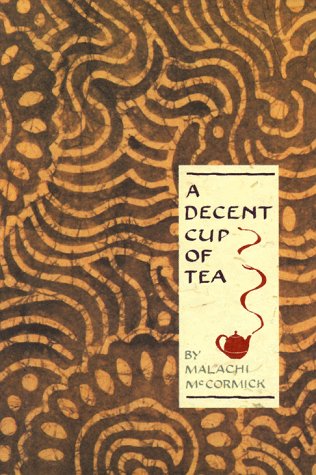
A Decent Cup of Tea

Last night I re-read after many years Malachi McCormick's slim volume from 1991, A Decent Cup of Tea.


I remember finding the book while I was in college on one of our very regular Friday night jaunts to the Barnes & Noble near school.  I bought a first copy as a gift, and on reading some of it before I bought it, had to buy a copy for myself.  Then, as now, I loved the the handmade feel of the book and the irregularly cut pages.  But the standout feature is the writing - easy to read, irreverent, and very human.

A Decent Cup of Tea was written for the same reasons I create dance workshops:  in response to a pet peeve.  McCormick was livid that even in London (at that time) you couldn't get a well-made cup of tea.  He found the same in his native Ireland, and especially in the US after he moved here.  This book was going to right that wrong.

The book was written before the rise in popularity of tea in this country - before there was a bubble tea fad, before everyone knew about the benefits of green tea, and before white tea was ever available outside of specialty stores.  McCormick very deliberately sticks to black teas and gives a brief synopsis of their history and spread in popularity from east to west.  He finishes his history chapter with the attempts to establish tea plants in the US, and effort that is still on-going.

The chapters go on through choosing a teapot, a few nice things to eat with tea, and the like, until we reach the climax:  the RIGHT way to make tea.  The chapter is 80% diatribe and 20% instruction, all sound, and no doubt convincing.

Although I am not nearly as vehement about my tea, I happen to agree with McCormick about the right way to drink tea, and certainly the right way to prepare it.  It's for all of the reasons that he states that I gave up drinking dining hall tea in college and switched to coffee.  Tea became the beverage we drank at night, every night, in the dorm, where we could be sure to prepare it the right way.

A few passages stood out in particular as I read last night:
  • In advocating for loose leaf tea, McCormick says, "Tea bag tea is safe tea.  Make mine loose."
  • He says that afternoon tea should be more of a social occasion than a meal.  Lighter fare is appropriate so it doesn't overpower the flavor of the tea.
  • Tea is something we do with and for our friends.
  • In another jab at tea bags:  "If we use tea bags, can we be said to have a future?"
 McCormick's final chapter is about reading tea leaves, something else I did quite a bit of in college, using this book and another as a guide.  He reminds us that tea leaf readings should be in response to questions or concerns, with the reader providing a frame and the beginning of the conversation.  It's the participatory nature of tea leaf readings that make them so much fun.

I discovered that Harney & Sons, purveyor of fine teas, have a Malachi McCormick blend called Decent Tea.  Now I want to try it.


 Next Week:  something seasonal before the autumn gets away from us - Holiday Pumpkins!

10/29/2014

The Cheese Course

This week I read a book by Janet Fletcher from 2000:  The Cheese Course.


Ever since Tria opened in Philadelphia, with it's long cheese menu, and artful presentations, I've been looking for the book that would tell me what to serve cheese with.  At Tria, cheese selections always come with the perfect pairing of honey, or figs, or walnuts, or something like that.  But most of the books out there, in my very limited search, seem to concentrate on what wines to drink with cheese.  I wanted to know about food pairings, and I hoped that the Cheese Course would tell me everything.

The introductory chapter of the book is chock-full of information about cheese:  what to look for in the shop, how to serve it, how to store it (plastic wrap is a no-no), etc.  Before getting into specific recipes, Fletcher offers some general advice about assembling cheese platters - how to intentionally feature one kind of cheese, and what assortments might work best. 

Fletcher advocates for having the cheese course at the end of the meal rather than before it.  She says that when you serve cheese as an appetizer, guests tend to eat too much, which ruins their dinner.  But cheese as a last course offers a way to lengthen the meal, to re-open conversation, and allow people to linger a little bit longer over a communal food.  (I'll say in support of this theory that the one time I had a cheese course at the end of the meal, it was extremely well-received!)

One piece of information in this chapter has stayed with me, and has partially answered the question of why I find wine pairings, but not food pairings for cheese:  if you are planning a food accompaniment to your cheese, wine is often not the best beverage to serve, especially if you are featuring fruit.  The flavors of fruit and wine may compete with rather than complement each other.  Fletcher than offers other beverage suggestions, including dessert wines, or even beer, that may work well with your cheese and other food selections.  The key take-away for me was wine or food, but maybe not both.

The recipe chapters were divided by milk source:  cow, goat, sheep and mixed.  Rather than a cheese with one food pairing, the recipes were mainly salads with a featured cheese, or a baked bread or pastry with cheese.  Several cheeses were served with dried fruit reconstituted with brandy or other alcohol.


The image above shows sheep's cheese with oven-dried tomatoes and roasted almonds.  I definitely want to try a particular kind of French sheep cheese with cherry preserves. 

The answer, of course, to my question and search for the definitive set of rules about what foods go with which cheese is that there are no rules.  Tastes differ, and the only way to figure out what works is to try everything and see what works for you.

If you are a cheese fan, check out Janet Fletcher's website, which contains information about all of her books, recipes, listings of cheese classes, and links to her reviews of cheeses in the San Francisco Chronicle.

What are your favorite kinds of cheese, and what do you eat them with?

Next week, one of the first tea books I ever owned, A Decent Cup of Tea by Malachi McCormick.