Showing posts with label Tea. Show all posts

12/14/2015

Checking back in...

Hmmmm...  Last post on April 1st...  As spring turned into summer, then fall, and now, almost winter, time and tea books got away from me.  I actually took several tea books away with me on vacation at the end of May, and wrote notes about 2-1/2 of them.  The notes are still sitting in my notebook, as yet unpublished.  But as of this weekend, it feels as if my major obligations for the year are finished (okay, that's not really true, but it feels true), so here we go again with another attempt...

(Of course, part of the time crunch is my second blog, Joanna Creates, which I'm using to capture my forays into arts and crafts.  I have updated there somewhat in the interim...)

One thing I've done a little of recently, despite telling myself I wouldn't, is buy magazines.  I don't have many - probably half a dozen assorted issues purchased at the bookstore waiting to be read, and another half dozen from a short-loved subscription to Martha Stewart Living.  In the first stack are two issues of Tea Time, which I think used to be called Southern Lady Tea Time after its parent publication.  It says on the cover that it it the winner of the Best Tea Publication.  I could be wrong, but it's certainly the only tea publication I've seen recently on the shelves at Barnes and Noble...  I have this year's September/October issue and November/December issue.  I'll review each separately as a way of easing back into book reviews.


The editor's letter of the September/October 2015 issue of Tea Time promises that that magazine will be full of "autumnal inspirations."  This is borne out in various articles including the tablescape piece and the themed tea parties.  The tablescape article talks about using one china pattern, "Autumn," by Lenox, in different ways for an elegant or more casual look by pairing it with various other china patterns, tablecloths or placemats, crystal, and other decorations.  This article isn't specifically tea-themed, but applicable to tea parties and the vibe of the magazine in general.

Tea Time has three themed teas:  Apple, Grandparent's Day, and Harvest Moon.  Each tea party has recipes and recommended tea pairings.  It's easy to connect apples with autumn and understand how the recipes and the tablescape for the party fit the theme.  Apparently Grandparent's Day happens in September or October, but it seems to be just a good excuse for a party as the recipes and decor have no real connection to the theme.  It might have been nice for this one to have some activities one might do in observance of this made-up holiday involving photos or family trees or something like that.  The last tea in honor of the harvest moon features the table setting from the magazine's cover and does include decor suggestions relating to the theme.  The recipes for this one seem more in harmony with the color scheme and china pattern than with the actual harvest.  One note about the tea pairings:  they all seem to be suggestions based on the magazine's advertisers, and not necessarily the best tea for each course drawn from a large, objective list.

Tea Time always reviews tea rooms.  Often tea rooms in one particular US state are featured.  This issue covers New Jersey, and a tea room outside of London.  The eight NJ tea rooms featured all seem to have opened in the last 10-15 years, or more recently.  I wonder if this is an inadvertent comment about the likelihood of tea room longevity, if there are older, more established tea rooms out there, and if those in the article will still be there by the time I get to visit these tea time destinations in my neighboring state. 

One of my favorite features of Tea Time is its articles about tea tools:  teapots, cups, furniture, etc.  This issue covers the gaiwan cup and the Brown Betty teapot in seperate articles.  I've been hearing more and more about gaiwan cups as I read more books and blogs written by true tea afficianadoes (as opposed to those more focused on tea as an occasion).  I think I understand how to use a gaiwan, but the article was only a glimpse, and not an instruction guide.  I'll call the article a success as it made me want to learn more.  We use a Brown Betty as our daily, go-to teapot, and that article made me want to check the bottom of the pot to see if it's the genuine article...

In general, Tea Time's content is purposefully light.  It caters to the tea party set, which I count myself a part of, not those in the industry and a part of the global, non-white world of tea and tea drinking.  It has articles by three mainstream luminaries:  James Norwood Pratt, Jane Pettigrew and Bruce Richardson.  Its resource lists, which I'm glad exist on general principles, cover china patterns and their prices and recipes, and not bibliographic information.

It'll be interesting to read the November/December issue in quick succession with Sept/Oct, and see what's the same, what's different, and how this magazine reflects a certain part of the US tea-drinking world.

3/31/2015

Time for Tea

This week, I read Time for Tea; Tea and Conversation with Thirteen English Women by Michele Rivers, published in 1994.


This is another tea book I bought, sight unseen, and haven't gotten around to reading until now.  I was intrigued by the premise of the book.  It is neither a book about the tea table nor a recipe book, though it does include some recipes.  Rather is is simply a series of conversations with actual people to try and capture why the tea time ritual is important in their lives, if it is at all.  The idea is that tea in England is only rarely the lace cloth and best china kind of event.  Tea as an event, or simply a beverage come in all forms.  This book is a glimpse of some of them.

The women interviewed for the book vary:  a farmer, an artist, bed and breakfast owner, grocery store check-out person, a Lady, a Marchioness, a six-year old, etc.  None live in London; most seem to have children.

Each chapter begins with a description of the interviewee - a bit about her life, history, job, etc.  The heart of each chapter is the interview, which is presented as an essay by the subject.  Each story is different, but you can almost hear the author begin each interview in the same way: "tell me about tea time - what it is, and what it means to you."  The essay begins with tea, or touches on it in some way, but each chapter takes off from that point.  We learn about the features and the challenges of daily life, raising children, dealing with divorce, hectic schedules, animals and guests that need to be fed.  Many of the women have had big transitions in their lives - new careers, second husbands, etc.  For each woman though, it seems that tea plays a similar role in their lives, even if they don't perceive it in that way.  Tea time is a pause in the routine, whether it comes daily, weekly, or only occasionally.  It's not a grab-and-go beverage like coffee, but a moment to stop and reflect or stop and chat for a second, or simply take a brief break from the race.

The final interview with two teenagers sums things up well.  Even if the subjects don't think that tea is a part of their lives, it somehow is.  They all drink more tea than they think they do.

So what role does tea and tea time play in your life?

2/11/2015

Passion for Tea

I'd put this week's book on my Amazon wishlist a while ago.  The cover is so compelling...


And while I like nothing better than browsing for and buying books online, it will never beat being able to pick up a book, read the back or the flyleaf, and truly evaluate whether or not it gets into your collection.  So yes, I judged a book by its cover and failed...

Beverly Rorem's book from 2008 reminds me of nothing so much as a coloring book.  It shares those dimensions and soft-cover quality.  And while there are no pictures to apply my crayons to, the book might be improved by their inclusion.  But maybe I'm just too critical.

The author is clearly on a crusade.  She is not a tea expert (and not a writer), but a self-taught tea lover.  She opens the book saying that, "tea is sexy, tea is glamourous, tea is funky," but her examples don't demonstrate these ideas.  Just because there is a tea shop in the East Village doesn't mean that tea is funky.  The availability of more than one kind of tea at Caesar's Palace in Las Vegas does not make tea glamourous.  There's just no evidence in this book that tea is sexy at all.  But Rorem is certainly ardent, if not articulate.

The book jumps all over the place in terms of topics.  It reads like a grade school book report:  I've read a lot of stuff, now let me relate it all to you.  The author mentions Starbucks twice in the first ten pages and five times by page 40, as if mentioning a popular coffee establishment will lend tea and this book credibility.  She also tells you to read Wikipedia to research certain tea topics.  The bibliography credits several articles from the Encyclopedia Britannica as sources for the book.

The book concludes with a long chapter on all of the health benefits of drinking tea and includes snippets on how tea can cure anything from ADD to Alzheimer's, and everything in-between.

Passion for Tea, while clearly passionate, is a clear example of the perils of self-publishing.  In some ways I hope the author didn't have an editor, because this work does not do anyone credit.

But the cover is pretty!

1/15/2015

The Essential Tea Companion

This week's book brings us to the last of my Victoria Magazine tea books.  Victoria has since started publishing annual tea-themed magazines, but more on that some other time...


The Essential Tea Companion from 2009 essentially re-purposes much of the content from Charms, Pleasures and Art.  In this volume, there is no one author because it is a compilation and even says so.  I suspect Kim Waller is the main contributor because of her part in the previous volumes, but this is unclear and unstated in the book.  Many of the pictures are of settings familiar from the previous books, but they are different shots of the same setting from those that appeared previously.

In tone, this book is much the same as Pleasures and Art, but there are a few key differences:

-It is very clear that this book is about tea parties and tea things.  It's nice to finally have that out there, and have all of the extra bits gone.  There are no preemptive interviews, no pieces of random text just stuck in there.  Just parties and stuff.  Fine.
-The pictures have captions!!  The captions don't always tell you the name of the china pattern or the source of the thing, but they do relate the pictures to the text, which is a start.
-Recipes are back, and there are lots of them.

But still and all, the book is very much in line with the concept of Victoria Magazine and the idea that life is or can be a blissful fantasy.  For example, there is a section on the prevalence of the silver tea service and how its popularity declined after WWII (which is why you should seek them out at antique stores and vintage sales and snap them up!), but no practical advice on how to polish, clean, store, and preserve your silver tea things, or any of your other tea wares.  It's almost as if covering that topic would break the romantic spell of Victoria.  It's also a lost opportunity to segue into the joy of home organization, natural cleaning products, and, of course, butler's panties, but again, I do appreciate the clear focus on parties and stuff.  And if Victoria or anyone else published a book on butler's pantries, I would buy it for sure!

Next time, I have one last Victoria book to share with you:  Table Settings!

1/07/2015

The Art of Taking Tea

This week's book review is a strong echo of last week's review of the Pleasures of Tea.  The Art of Taking Tea was published by the Editors of Victoria Magazine in 2002.  It is again written by Kim Waller (who is again uncredited on the cover).


In much the same way as Pleasures, Art is loosely organized around three themes, but within each section, veers off topic into subjects that are vaguely, but not exactly related.  Part one is sort of about the history of tea including the tea trade and the introduction to tea to the West.  It includes information about the harvesting and the preparation of tea leaves, and then suddenly jumps to a section on silver tea wares and the Victorian custom of having an "at home" day.

Part two is about going out to tea and features three locations in particular:  Tealuxe in Cambridge, MA,  the café at Takashimaya in NYC (now closed), and Laudrée in Paris, most known for its colorful macarons (Does anyone go to Tealuxe?  Will someone take me to Laudrée right now?).  There are sections on tea at an English country house and how to have an Asian aesthetic at teatime at home.

Part three is about different occasions for tea:  tea in bed, tea as a theme for an office party, tea picnics, tea and wedding celebrations, tea dances, etc. 

The book is pleasant, inoffensive, but reads like a magazine in terms of overall flow.  Somehow the title, "The Art of Taking Tea," is just one that sounds nice rather than what this book is clearly about.  The pictures are lovely, but not captioned (I do love that pink Jasperware on the cover).  The interviews are only in passing, and not long enough or in-depth enough to add.  Interesting differences to note in this book, as opposed to Charms and Pleasures:  there are no recipes, and by 2002, all of the businesses listed in the resources section have web addresses!

Next week:  one more Victoria book to go - The Essential Tea Companion

12/31/2014

The Pleasures of Tea

After the other week's dismaying read-through of the Charms of Tea, I decided to jump right in and read the other Victoria Magazine tea books I have (three others!).  This week's offering:  The Pleasures of Tea from 1999.  Like Charms, this book has no author's name on the cover, but the blurb on the book jacket reveals the author to be Kim Waller, who was a Victoria editor.  So we know that the text was written for the book, and not culled from the pages of the magazine.


I began the book with some trepidation, but I was eager to read the text in hopes it would be less horrifying.  It was!!  And it's right in the foreword.  The editor drinks tea from mugs and admits that afternoon tea is a privilege.  The book even acknowledges that people work, and that a tea break can be beneficial at a low point in a business meeting.  What a relief!

The Pleasures of Tea is a bit disorganized but focuses on tea-drinking occasions, equipment, and recipes.  The prose is a little flowery, but inoffensive.  It's also rather brief.  There are three "interviews" in the book - with a tea grower, a tea seller, and a tea salon owner - but all three go into no depth, which is a loss, and could have added greatly to the quality of the book. 


The strong point of Pleasures is the middle section on tea wares.  There are pages of photographs devoted to teapots, Wedgwood, chintzware, etc.  In fact, the book brings in tea equipment right away.  In the first chapter, the Daily Cup, the author says, "There is a ritualistic comfort in using pretty objects you love."  I agree.  I love tea things and devour these sorts of pages eagerly contemplating china patterns to search for, and lamenting that I don't have a strawberry fork.  So for me, the irksome part is the picture captions.  Sometimes they say what the china pattern is, but often not.  And even in the reference pages in the back, they list the photographer of each photo, but no other information such as location or source of the materials.  There are some photos with some great teacup and teapot image fabrics, but if I wanted to find those curtains, I would have no idea where to start!

This is a pretty book to have and read, though by no means perfect. I can't wait to see where the next Vicotria tea book, the Art of Taking Tea, takes us.  Stay tuned!!

Incidentally, this month I used holiday shopping as an excuse to get a bunch of new books (thank you Amazon used books!).  Maybe I'll get to reviews of these titles in the coming year:

12/23/2014

The Charms of Tea

When I was in junior high and high school and the world seemed bleak much of the time, one of the things that gave me solace was Victoria Magazine.  Victoria portrayed a fantasy world - a world I very much wanted to live in - where women collected vintage linens, had time to create and tend beautiful gardens, lived in old houses which they rehabbed by themselves and then furnished impeccably, and took time for tea everyday.  I read every issue from cover to cover, even if I fell behind.  And then once I got to college, my mom kept up my subscription, but I stopped reading.  Reality had so much improved that I no longer needed that particular fantasy.  But my love of tea and books about tea grew, and my collection of tea books includes, I think, three books about tea published by Victoria through the years.  Today we'll look at the first of those, The Charms of Tea
which was published in 1991.


The book has no stated author, but may be cobbled together from the pages of the magazine.  There are chapters around a specific theme like the Victorian Tea, the Social Tea, and the Proper Setting, but following one page of text, in and among lovely photographs, are excerpts from literature and selected quotes about tea time, tea parties, etc.  There are snippets from Oscar Wilde, Peter Pan, Rebecca, Anne of Green Gables, and all of the typical quotes one reads in books about tea.


Coming back to this book and the words of Victoria authors after all these years was a bit of a rude awakening.  I know it was always like this, perhaps in the name of creating and sustaining that fantasy of "the beautiful life," but really...   The second paragraph of the introduction reads, "the custom of the afternoon tea has been popular among civilized people for centuries."  It's hard to even begin on that sentence and deal with the judgment-laden text here and all that follows.  Later on, "at 4, every kettle in the empire began to whistle."  Every one?  Really?  I love all kinds of entertaining and tea party paraphernalia, really I do, but even I don't believe that you can't possibly have a tea party if you don't have tea cups of the thinnest bone china.  You can.  You should. 

Possibly my favorite part comes in the back of the book when they are starting in on the recipes.  At the beginning of the first food chapter is the obligatory bit about how to prepare tea.  After all of the nonsense about the china and the sugar tongs and all of that, they say that tea bags are acceptable for tea party use!  It's this little bit that encapsulates the book - this is about tone, and elegance, and home furnishings, and being very upper, but really, the tea itself is of the least importance.  Fascinating...

Text aside, some of the recipes look tempting, especially the quickbreads.   I really want to make the milk and honey bread with honey butter.  It's possible that you might see raspberry and lemon curd hearts sometime soon...

In 2003, Victoria went out of print.  It was resurrected in 2007.  In all fairness, I have not read the new version, and I have no idea if the text or the tone is the same as the version I read and enjoyed back in the day.  Does anyone know?

My overwhelming feeling is that Martha took over where Victoria left off - for me, anyway.  And as much as I still want to look and dress like a Gibson Girl sometimes, and as much as Martha is still out of touch with reality as I live it, I'm glad my level of fantasy, and my taste in magazines has shifted.

11/25/2014

A Proper Tea...

This week's book, A Proper Tea by Joanna Isles, is another early addition to my tea book collection.  It was published in the UK in 1987.  I bought it some time in the early 90s.


A Proper Tea is one of my favorite kinds of books about tea.  It opens with some basics about the history and the proper preparation of tea, like many tea books do, but the heart of the book are the chapters devoted to different types of tea occasion, the perfect tea for that occasion, and accompanying recipes.  Each chapter is illustrated by the author, using real china patterns as a basis for the watercolors.

Tea Outing
Two of my favorite teas, Darjeeling and Yunnan, are paired with A Proper Tea and Tea by the Fire.  Another appealing pairing is Keemun tea for a Black & White Tea. 

A Proper Tea
The most memorable chapter is called A Bizarre Tea, inspired by the 1920s tea and china sets designed by Clarice Cliff in bold shapes and colors.  The recipes in this chapter include orange-flavored sweets to echo the art deco designs.

Clarice Cliff's Bizarre Ware

The Black & White Tea chapter is an attempt to promote the tea party to a contemporary audience.  The recipes feature caviar-filled treats, all based around a sophisticated, minimalist color palette.  The author was writing at a time when tea had fallen in popularity compared to coffee and other beverages, even in the UK.  The author hoped that by showing a modern tea party example, she would convince readers that tea time and the tea party was not helplessly old-fashioned, but adaptable to current styles and habits, and well worth reviving.

Twenty-seven years later, tea and the tea party still survives.  Is teatime still a daily ritual in the UK?  It never was here in the US, which may or may not be related to the Boston Tea Party.  In my little piece of the world, having a tea party, going out to tea, or even a solo cup of tea at the end of the work day is still a moment of calm, a treasure in the middle of a hectic life.  I wonder if I would feel that way if it was just part of the daily pattern...

Next week:  A Proper Breakfast

11/04/2014

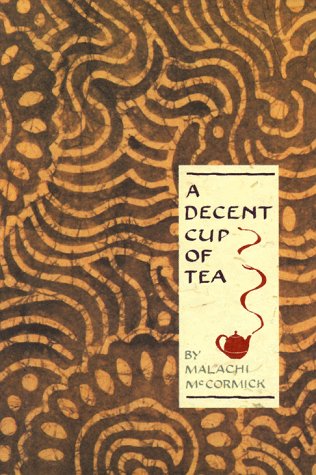
A Decent Cup of Tea

Last night I re-read after many years Malachi McCormick's slim volume from 1991, A Decent Cup of Tea.


I remember finding the book while I was in college on one of our very regular Friday night jaunts to the Barnes & Noble near school.  I bought a first copy as a gift, and on reading some of it before I bought it, had to buy a copy for myself.  Then, as now, I loved the the handmade feel of the book and the irregularly cut pages.  But the standout feature is the writing - easy to read, irreverent, and very human.

A Decent Cup of Tea was written for the same reasons I create dance workshops:  in response to a pet peeve.  McCormick was livid that even in London (at that time) you couldn't get a well-made cup of tea.  He found the same in his native Ireland, and especially in the US after he moved here.  This book was going to right that wrong.

The book was written before the rise in popularity of tea in this country - before there was a bubble tea fad, before everyone knew about the benefits of green tea, and before white tea was ever available outside of specialty stores.  McCormick very deliberately sticks to black teas and gives a brief synopsis of their history and spread in popularity from east to west.  He finishes his history chapter with the attempts to establish tea plants in the US, and effort that is still on-going.

The chapters go on through choosing a teapot, a few nice things to eat with tea, and the like, until we reach the climax:  the RIGHT way to make tea.  The chapter is 80% diatribe and 20% instruction, all sound, and no doubt convincing.

Although I am not nearly as vehement about my tea, I happen to agree with McCormick about the right way to drink tea, and certainly the right way to prepare it.  It's for all of the reasons that he states that I gave up drinking dining hall tea in college and switched to coffee.  Tea became the beverage we drank at night, every night, in the dorm, where we could be sure to prepare it the right way.

A few passages stood out in particular as I read last night:
  • In advocating for loose leaf tea, McCormick says, "Tea bag tea is safe tea.  Make mine loose."
  • He says that afternoon tea should be more of a social occasion than a meal.  Lighter fare is appropriate so it doesn't overpower the flavor of the tea.
  • Tea is something we do with and for our friends.
  • In another jab at tea bags:  "If we use tea bags, can we be said to have a future?"
 McCormick's final chapter is about reading tea leaves, something else I did quite a bit of in college, using this book and another as a guide.  He reminds us that tea leaf readings should be in response to questions or concerns, with the reader providing a frame and the beginning of the conversation.  It's the participatory nature of tea leaf readings that make them so much fun.

I discovered that Harney & Sons, purveyor of fine teas, have a Malachi McCormick blend called Decent Tea.  Now I want to try it.


 Next Week:  something seasonal before the autumn gets away from us - Holiday Pumpkins!

10/07/2014

A Guide to Tea

 This weekend I had a chance to read one of the books I bought at the Free Library used bookstore last week.  I started with this one, A Guide to Tea.


Note there is no author's name on the front cover of the book. This should be the first clue of what's to be found inside...

A Guide to Tea, while pleasant enough, is really some kind of advertising/marketing piece for Adagio teas.  Not only does it not have an author until you get to the title page, there is no publisher, no photo credits, and no publication date, I suspect so it can't get out of date for as long as Adagio wants to sell it (which I don't think it's doing anymore...).  Amazon reports the date as 2005.  Apparently the author, Chris Cason, is a real person, and really a tea guy.  He may or may not be the tea sommelier for Tavalon Teas.

The book, though about 85 pages in length, is fairly low on content.  (In fairness, it doesn't pretend to be otherwise.)  It ranges across many topics from how to brew tea to where does tea come from to tisanes, but it goes into none of these areas in depth.  The writing is informational, with the unfortunate addition of unnecessary witticisms and/or colloquialisms that seem to be added as an afterthought.  Why?  Why the strange opening justifying the existence of the book because of the Boston Tea Party?


I enjoyed the fact that this book is not a recipe book, but really a book about tea.  Often tea books are just cookbooks with an opening chapter about tea types, etc., but this book stuck to the subject.  It includes many beautiful pictures, uncaptioned and uncredited, but supposedly of Asian and Indian tea plantations, workers, and tea in situ.  But the pictures seem unrelated to the chapter at hand, except in the most general sense. 

I'm happy to have this book, though it will never be a go-to reference guide.  I wonder what the impetus was to publish it to begin with, and whether it was considered to be a success.  Have you heard of it?  Have you read it?  What do you think?

Next week:  Tabletops by Barbara Milo Ohrbach

1/24/2012

Tea party!

After many false starts, Jennifer and I threw our first small tea party on a snowy Saturday. Jennifer provided the sweets; I contributed the savouries and scones. It was a great chance to use some of my hidden, stored, and packed away tableware, some of it for the first time!

The tea table at a glance:


Even though there were only six of us and an extra leaf in the table, there was not an extra inch of room for anything! The teapots were on the breakfront.

I used a mix of china, which is not the norm for me - a set of cups and saucers that are a favorite gift from my college friends, a sugar and creamer set that matched the tea plates, and a honey pot from another set altogether.


The savouries included three kinds of sandwiches and a board of Manchego cheese served with homemade quince jam and paté served with sliced baguette. Yum! And check out those cinnamon chip scones. I served those with Devonshire cream.


And every tea has its princess! Joy fit the bill nicely. She even brought her own tiara!


I hope this tea is only the first of many. See all of you for tea in the Spring??

12/23/2009

Some day it may come to this...

Isn't this amazing:


This image comes from Just Be Splendid via Teaspoon and Petals. And yes, I really love the purple one with polka-dots...

11/15/2009

Tea Room Review - Arium

The sun is finally shining here this morning! Not so yesterday in NYC when our lovely outing day was plagued by intermittant showers. But the rain did not deter from theater, tea and dancing, i.e., a pefect combination of events!

After seeing Love, Loss, and What I Wore at the Westside Theater, we headed down to Arium for afternoon tea. In our family, we have a tradition of having real, official, afternoon tea on the day after Thanksgiving. While it hasn't really worked to have tea on that day in the past several year, it's not working to have tea that weekend at all this year. So yesterday was substitute.

Finding the perfect place for tea can be a challenge. We like trying new places, if we can. We like the full, three-course, sandwiches, scones, and sweets tea without excessive cutesy floral romance, but with a certain formality that marks a difference from coffee and a small cake or pastry at a cafe.

Deb was on the case, and found seemingly the perfect place: Arium, down in the revamped, now trendy meat packing district, on a street with one of the best names ever: Little West 12th.

Arium was lovely in many respects. The atmosphere was nice - good furniture, formal serviceware, but simple. The food was good, though I prefer my scones a little less cake-y and more biscuit-like. The service was good. We were served quickly and not rushed. The tea selections were great, far beyond the usual one type of green, a darjeeling, an earl grey, and maybe an oolong for variety, with a list of trendy non-teas. I had two of my favorite Yunan types to choose from. I selected an Emperor's Red from Fujian Province.

But here's the kicker - there were no other people in the place. And not just the tea part of the place. This so-called design studio is really an upscale hair salon. It used to have a gallery, but that has been replaced by headshots of models with interesting hair. And though the place serves lunch, dinner and tea and is in a trendy location, it was empty but for us.

My overwhelming thought when we left was that Arium wouldn't be around for long. I'm glad we caught it in its brief moment of existence.

9/18/2009

Tea time accoutremonts...

From one of today's Design*Sponge posts:


From the tea accessories collection by Bodo Sperlien for Yauatcha Atelier. I don't even want to know what they cost...

6/09/2009

Someone else's story...

Sometimes I think the real purpose of many of the blogs I follow is to spread news around, not to post new and original ideas. This post will emulate that line of thinking...


Image: Kriss's Color Stripes. This image reminded me that I have a couple of shelves to put up in my craft room but haven't gotten around to doing so. I love this idea of an instant shelf/hutch that incorporates storage for small items. I could probably make this happen with some of my sets of stamp drawers from Ikea...

Next find: Are you ever in a cafe, trying to keep track of the time so that you don't over-steep your tea, but in danger of being distracted by whatever else is happening on your laptop? Well, now there's a website just for you (this thought from Teaspoon & Petals).

Well, two unoriginal ideas will have to suffice. Perhaps more to come from my house, garden, life when the miasma of this cold and current streak of weather lifts...

5/13/2009

On the shelf...

This idea from Design*Sponge struck my fancy today:


Simple and elegant, combining the best of my grandfather's shelf of screws and nuts and bolts with tea. But where can I put it?

8/08/2008

7/27/2008

Madame will be at home...

It's been so delightful having a weekend at home and even more exciting to realize that other than a quick hop to Boston mid-week and a weekend in New York coming up, I'll be at home for several weeks in a row!

Yesterday was taken up by car stuff, my Container Store oddysey, moving rocks and pulling weeds in the front grassy patch (the backyard is a certifiable jungle - so embarassing - next week's project...), moving food around in the kitchen, and finally, dancing. Today was great - the freedom to sleep in, run lots of errands (learning how to drive the new car), enjoy the pool party, and watch little Ms Esmerelda.

Among other errands this weekend was a stop back at Bed Bath and Beyond. The brown slipcovers are now no more. The next experiment: twill slipcovers from Target. Color: milkshake.


Yes, I know it's a ridiculous color to contemplate, and that that they will stain. I passed a place that makes custom slipcovers, but if I went that route, I might as well get the current ones reupholstered, or simply buy new. But I have to keep trying to find something I like, and brown wasn't it. I'll keep you posted.

Another fun stop today was the new-ish tea place in Chestnut Hill: The Hill Tea Bar. It seems small, but charming with indoor and outdoor seating and antiques from the shop next door on display. There are tea tastings and wine tastings and story hours for the kiddos. Their hours are somewhat in flux as they get a feel for the neighborhood, so I put in my request for a late Friday or Saturday night. Who wants to go for tea?

1/20/2008

I think Susie would agree that one of the key things to a house purchase is making sure there are good spots to have tea. Some things that might contribute:


A window seat and a fireplace...


Of course what's really important for tea is just good friends, boiling hot water, a few mugs, a few leaves.


But here are a few of my favorite additions to teatime:


Good tea. Tea that is not ancient (I refuse to comment on the age of my own personal stash of tea. Must drink more tea.). My favorite stuff comes from Upton Tea Imports based in Hopkinton, MA. The have a wide selection of black and green teas, decaf, white, tisanes, you name it. They also have accoutrements for tea: pots, cups, strainers, etc. I tend toward black teas from china (though you just can't beat a good Darjeeling). My favorite is Sichuan Zao Bei Jian. It has excellent flavor and slightly more kick than the mellow Darjeeling without the strong astringency of an Assam. Because I don't order tea very often, I live in fear that it will be gone next time I place an order...


And what to enjoy tea in? I previously mentioned Bodum's doublewalled glasses and mugs. They're just so much fun to drink from - everybody needs these!


I have many teapots, but in the past few years I've fallen in love with a hard-to-find collection of Japanese teaware made/distributed by a company called Tampopo (Dandelion)


I came across it by accident. I went ot one of Deb's Stonewall concerts in Park Slope once. We were early and so Eileen and I browsed through the artsy stores. In one I found two of the Tampopo bowls, pieces from a set that had been broken up. The shopkeeper had no idea what the brand was on the bottom (in Japanese), or anything else about them. But I loved them and bought them. I few years later, in a new Philadelphia teashop, I found more pieces - cups, teapots, etc. Still later, I found more pieces in a shop in Northampton, MA, where I bought a bowl, and finally learned the manufacturer's name. Deb has found pieces in NYC for me. I actually know of two places where I can find it near hear - a gourmet shop in Old City and a Kitchen/dining ware place in Peddler's Village in Lahaska. I still want the sets of plates, bowls, well, anything...

I'm sort of glad it's hard to find. I know of a couple of sources, but it's pricey. But beautiful. And hard to resist.

When are you coming for tea?

1/12/2008

A cafe a day...

Where better to begin this electronic adventure than Remedy Tea Bar, one of the rare cafes in town that's really all about tea.


Secret reason why I really love Remedy - double-walled glasses. This is where I first encountered the wonder that is Bodum's wonderful contraption - the double-walled cups that allow you to see the color of the tea and touch the glass without buring your hands. I love them. I have a bunch at home in various shapes - canteen, bistro, pavina. Never enough.


Other reasons to love and patronize Remedy: This is an actual tea cafe. They don't serve coffee. And not only do they serve highly decent tea, they serve black tea. No, this is not some chichi froufrou tea place that has bubble tea and every kind of bland white tea out there. Well, they have those too, and even those strange non-tea teas (yes, tisanes) but they don't neglect the other end of the tea scale - the fine Darjeelings and Yunnans. Yum.


And it's not pretentious. It's easy to sit here and chat, read your email or do anything else. The music isn't intrusive and the bathroom is clean. I don't see any outlet to plug in this fine laptop, but I'm hoping I just didn't look hard enough.


I'm afraid that Remedy will only have a short life, that its location on Sansom, behind the more obvious Walnut will hide its existence, and in too short a time it will go away. So meet me for tea here sometime, would you?


From my notebook:

Other free internet sites:

Reading Terminal Market
Love Park
Ant Pants Cafe - 2212 South Street
Bean Exchange Cafe - 650 Bainbridge Street
Brew Ha Ha - 212 S. 12th Street
Chapterhouse Cafe - 620 S. 9th Street
Last Drop - 1300 Pine Street
T-Bar - 117 S. 12th at Sansom