After the other week's dismaying read-through of the Charms of Tea, I decided to jump right in and read the other Victoria Magazine tea books I have (three others!). This week's offering: The Pleasures of Tea from 1999. Like Charms, this book has no author's name on the cover, but the blurb on the book jacket reveals the author to be Kim Waller, who was a Victoria editor. So we know that the text was written for the book, and not culled from the pages of the magazine.
I began the book with some trepidation, but I was eager to read the text in hopes it would be less horrifying. It was!! And it's right in the foreword. The editor drinks tea from mugs and admits that afternoon tea is a privilege. The book even acknowledges that people work, and that a tea break can be beneficial at a low point in a business meeting. What a relief!
The Pleasures of Tea is a bit disorganized but focuses on tea-drinking occasions, equipment, and recipes. The prose is a little flowery, but inoffensive. It's also rather brief. There are three "interviews" in the book - with a tea grower, a tea seller, and a tea salon owner - but all three go into no depth, which is a loss, and could have added greatly to the quality of the book.
The strong point of Pleasures is the middle section on tea wares. There are pages of photographs devoted to teapots, Wedgwood, chintzware, etc. In fact, the book brings in tea equipment right away. In the first chapter, the Daily Cup, the author says, "There is a ritualistic comfort in using pretty objects you love." I agree. I love tea things and devour these sorts of pages eagerly contemplating china patterns to search for, and lamenting that I don't have a strawberry fork. So for me, the irksome part is the picture captions. Sometimes they say what the china pattern is, but often not. And even in the reference pages in the back, they list the photographer of each photo, but no other information such as location or source of the materials. There are some photos with some great teacup and teapot image fabrics, but if I wanted to find those curtains, I would have no idea where to start!
This is a pretty book to have and read, though by no means perfect. I can't wait to see where the next Vicotria tea book, the Art of Taking Tea, takes us. Stay tuned!!
Incidentally, this month I used holiday shopping as an excuse to get a bunch of new books (thank you Amazon used books!). Maybe I'll get to reviews of these titles in the coming year:
12/31/2014
12/23/2014
The Charms of Tea
When I was in junior high and high school and the world seemed bleak much of the time, one of the things that gave me solace was Victoria Magazine. Victoria portrayed a fantasy world - a world I very much wanted to live in - where women collected vintage linens, had time to create and tend beautiful gardens, lived in old houses which they rehabbed by themselves and then furnished impeccably, and took time for tea everyday. I read every issue from cover to cover, even if I fell behind. And then once I got to college, my mom kept up my subscription, but I stopped reading. Reality had so much improved that I no longer needed that particular fantasy. But my love of tea and books about tea grew, and my collection of tea books includes, I think, three books about tea published by Victoria through the years. Today we'll look at the first of those, The Charms of Tea
which was published in 1991.
The book has no stated author, but may be cobbled together from the pages of the magazine. There are chapters around a specific theme like the Victorian Tea, the Social Tea, and the Proper Setting, but following one page of text, in and among lovely photographs, are excerpts from literature and selected quotes about tea time, tea parties, etc. There are snippets from Oscar Wilde, Peter Pan, Rebecca, Anne of Green Gables, and all of the typical quotes one reads in books about tea.
Coming back to this book and the words of Victoria authors after all these years was a bit of a rude awakening. I know it was always like this, perhaps in the name of creating and sustaining that fantasy of "the beautiful life," but really... The second paragraph of the introduction reads, "the custom of the afternoon tea has been popular among civilized people for centuries." It's hard to even begin on that sentence and deal with the judgment-laden text here and all that follows. Later on, "at 4, every kettle in the empire began to whistle." Every one? Really? I love all kinds of entertaining and tea party paraphernalia, really I do, but even I don't believe that you can't possibly have a tea party if you don't have tea cups of the thinnest bone china. You can. You should.
Possibly my favorite part comes in the back of the book when they are starting in on the recipes. At the beginning of the first food chapter is the obligatory bit about how to prepare tea. After all of the nonsense about the china and the sugar tongs and all of that, they say that tea bags are acceptable for tea party use! It's this little bit that encapsulates the book - this is about tone, and elegance, and home furnishings, and being very upper, but really, the tea itself is of the least importance. Fascinating...
Text aside, some of the recipes look tempting, especially the quickbreads. I really want to make the milk and honey bread with honey butter. It's possible that you might see raspberry and lemon curd hearts sometime soon...
In 2003, Victoria went out of print. It was resurrected in 2007. In all fairness, I have not read the new version, and I have no idea if the text or the tone is the same as the version I read and enjoyed back in the day. Does anyone know?
My overwhelming feeling is that Martha took over where Victoria left off - for me, anyway. And as much as I still want to look and dress like a Gibson Girl sometimes, and as much as Martha is still out of touch with reality as I live it, I'm glad my level of fantasy, and my taste in magazines has shifted.
which was published in 1991.
The book has no stated author, but may be cobbled together from the pages of the magazine. There are chapters around a specific theme like the Victorian Tea, the Social Tea, and the Proper Setting, but following one page of text, in and among lovely photographs, are excerpts from literature and selected quotes about tea time, tea parties, etc. There are snippets from Oscar Wilde, Peter Pan, Rebecca, Anne of Green Gables, and all of the typical quotes one reads in books about tea.
Coming back to this book and the words of Victoria authors after all these years was a bit of a rude awakening. I know it was always like this, perhaps in the name of creating and sustaining that fantasy of "the beautiful life," but really... The second paragraph of the introduction reads, "the custom of the afternoon tea has been popular among civilized people for centuries." It's hard to even begin on that sentence and deal with the judgment-laden text here and all that follows. Later on, "at 4, every kettle in the empire began to whistle." Every one? Really? I love all kinds of entertaining and tea party paraphernalia, really I do, but even I don't believe that you can't possibly have a tea party if you don't have tea cups of the thinnest bone china. You can. You should.
Possibly my favorite part comes in the back of the book when they are starting in on the recipes. At the beginning of the first food chapter is the obligatory bit about how to prepare tea. After all of the nonsense about the china and the sugar tongs and all of that, they say that tea bags are acceptable for tea party use! It's this little bit that encapsulates the book - this is about tone, and elegance, and home furnishings, and being very upper, but really, the tea itself is of the least importance. Fascinating...
Text aside, some of the recipes look tempting, especially the quickbreads. I really want to make the milk and honey bread with honey butter. It's possible that you might see raspberry and lemon curd hearts sometime soon...
In 2003, Victoria went out of print. It was resurrected in 2007. In all fairness, I have not read the new version, and I have no idea if the text or the tone is the same as the version I read and enjoyed back in the day. Does anyone know?
My overwhelming feeling is that Martha took over where Victoria left off - for me, anyway. And as much as I still want to look and dress like a Gibson Girl sometimes, and as much as Martha is still out of touch with reality as I live it, I'm glad my level of fantasy, and my taste in magazines has shifted.
12/09/2014
A Proper Breakfast
Shortly after I began my love affair with tea books and purchased the subject of my last review, A Proper Tea, I came across this week's book in a catalog called Jessica's Biscuit: A Proper Breakfast. [Apparently, Jessica's Biscuit, which was a cookbook only catalog and website, has just ceased existence...]
At the time, I thought and hoped this book would be only the second in a series, but I think this was the only other book that followed the same pattern. It was never readily available here in the US, even before the era of Amazon. My copy of the book came complete with a small card explaining that the design and concept of the book was based on A Proper Tea by Joanna Isles. Clearly Alexandra Parsons and Evie Safarewicz followed the same ideas and designs of the previous book, even to the same degree that, as with the first book, the illustrations are more memorable than the recipes.
Breakfast is my favorite meal, closely followed by brunch. I love breakfast pastries, and the idea of a casual meal where bunny slippers are de rigueur. Breakfast has the full compliment of tasty foods and fancy/ridiculous equipage. I look for any excuse to break out my toast rack!
A Proper Breakfast is a very limited look at breakfast in other cultures (mostly Western cultures) from the point of view of popular expectations, and not necessarily what folks in those places actually eat on a daily basis. The New York breakfast features bagels and lox. Brunch in New Orleans features jambalaya. Breakfast in the Tropics is not about the Caribbean or South America, the way I expected it to be, but about Africa - the one non-Western chapter in the book. It's clearly the whimsical British look at breakfast traditions.
The opening chapters focus on the breakfast beverages of coffee, tea, and hot chocolate. I was so surprised to read the suggestion that jugs of coffee be prepared like tea: put the grounds directly in the pot, pour in the boiling water, stir, and pour out over a strainer. So odd. Who does that??
The best part of the book are the illustrations, which are similar in style to those in A Proper Tea. They feature drawn versions of actual china patterns and breakfast foods. It was fun to try and guess what each chapter would be about from the drawing at the beginning. My favorite is the New Orleans chapter with black and white china, iron scroll work curlicues and colorful masks and foods.
Overall, the content of the book is really the pictures. The recipes are common, and available anywhere, but the pages are worth browsing through for tablescape ideas, or even for art's sake!
Okay, I admit that one of the calendars I want for 2015 is this Breakfast Calendar...
At the time, I thought and hoped this book would be only the second in a series, but I think this was the only other book that followed the same pattern. It was never readily available here in the US, even before the era of Amazon. My copy of the book came complete with a small card explaining that the design and concept of the book was based on A Proper Tea by Joanna Isles. Clearly Alexandra Parsons and Evie Safarewicz followed the same ideas and designs of the previous book, even to the same degree that, as with the first book, the illustrations are more memorable than the recipes.
Breakfast is my favorite meal, closely followed by brunch. I love breakfast pastries, and the idea of a casual meal where bunny slippers are de rigueur. Breakfast has the full compliment of tasty foods and fancy/ridiculous equipage. I look for any excuse to break out my toast rack!
A Proper Breakfast is a very limited look at breakfast in other cultures (mostly Western cultures) from the point of view of popular expectations, and not necessarily what folks in those places actually eat on a daily basis. The New York breakfast features bagels and lox. Brunch in New Orleans features jambalaya. Breakfast in the Tropics is not about the Caribbean or South America, the way I expected it to be, but about Africa - the one non-Western chapter in the book. It's clearly the whimsical British look at breakfast traditions.
The opening chapters focus on the breakfast beverages of coffee, tea, and hot chocolate. I was so surprised to read the suggestion that jugs of coffee be prepared like tea: put the grounds directly in the pot, pour in the boiling water, stir, and pour out over a strainer. So odd. Who does that??
The best part of the book are the illustrations, which are similar in style to those in A Proper Tea. They feature drawn versions of actual china patterns and breakfast foods. It was fun to try and guess what each chapter would be about from the drawing at the beginning. My favorite is the New Orleans chapter with black and white china, iron scroll work curlicues and colorful masks and foods.
Overall, the content of the book is really the pictures. The recipes are common, and available anywhere, but the pages are worth browsing through for tablescape ideas, or even for art's sake!
Okay, I admit that one of the calendars I want for 2015 is this Breakfast Calendar...
11/25/2014
A Proper Tea...
This week's book, A Proper Tea by Joanna Isles, is another early addition to my tea book collection. It was published in the UK in 1987. I bought it some time in the early 90s.
A Proper Tea is one of my favorite kinds of books about tea. It opens with some basics about the history and the proper preparation of tea, like many tea books do, but the heart of the book are the chapters devoted to different types of tea occasion, the perfect tea for that occasion, and accompanying recipes. Each chapter is illustrated by the author, using real china patterns as a basis for the watercolors.
Two of my favorite teas, Darjeeling and Yunnan, are paired with A Proper Tea and Tea by the Fire. Another appealing pairing is Keemun tea for a Black & White Tea.
The most memorable chapter is called A Bizarre Tea, inspired by the 1920s tea and china sets designed by Clarice Cliff in bold shapes and colors. The recipes in this chapter include orange-flavored sweets to echo the art deco designs.
The Black & White Tea chapter is an attempt to promote the tea party to a contemporary audience. The recipes feature caviar-filled treats, all based around a sophisticated, minimalist color palette. The author was writing at a time when tea had fallen in popularity compared to coffee and other beverages, even in the UK. The author hoped that by showing a modern tea party example, she would convince readers that tea time and the tea party was not helplessly old-fashioned, but adaptable to current styles and habits, and well worth reviving.
Twenty-seven years later, tea and the tea party still survives. Is teatime still a daily ritual in the UK? It never was here in the US, which may or may not be related to the Boston Tea Party. In my little piece of the world, having a tea party, going out to tea, or even a solo cup of tea at the end of the work day is still a moment of calm, a treasure in the middle of a hectic life. I wonder if I would feel that way if it was just part of the daily pattern...
Next week: A Proper Breakfast
A Proper Tea is one of my favorite kinds of books about tea. It opens with some basics about the history and the proper preparation of tea, like many tea books do, but the heart of the book are the chapters devoted to different types of tea occasion, the perfect tea for that occasion, and accompanying recipes. Each chapter is illustrated by the author, using real china patterns as a basis for the watercolors.
![]() |
| Tea Outing |
![]() |
| A Proper Tea |
![]() |
| Clarice Cliff's Bizarre Ware |
The Black & White Tea chapter is an attempt to promote the tea party to a contemporary audience. The recipes feature caviar-filled treats, all based around a sophisticated, minimalist color palette. The author was writing at a time when tea had fallen in popularity compared to coffee and other beverages, even in the UK. The author hoped that by showing a modern tea party example, she would convince readers that tea time and the tea party was not helplessly old-fashioned, but adaptable to current styles and habits, and well worth reviving.
Twenty-seven years later, tea and the tea party still survives. Is teatime still a daily ritual in the UK? It never was here in the US, which may or may not be related to the Boston Tea Party. In my little piece of the world, having a tea party, going out to tea, or even a solo cup of tea at the end of the work day is still a moment of calm, a treasure in the middle of a hectic life. I wonder if I would feel that way if it was just part of the daily pattern...
Next week: A Proper Breakfast
11/19/2014
Holiday Pumpkins & Halloween Treats
This week, two reviews (to make up for my missed week)!
If you meet me, it will probably not take you long to learn the following:
Given this love-hate relationship, I find it a bit odd that I own not one, but two books that feature all things pumpkin-related. This week we look at two books published in 1998: Holiday Pumpkins and Halloween Treats.

Holiday Pumpkins, by Georgiane Brennan and Jennifer Barry begins with a chapter about pumpkin basics: which pumpkins are best to eat, how to grow and store pumpkins, how to cook and purée pumpkin, and how to prepare pumpkin blossoms (hint: watch out for hidden bugs). The authors say that pumpkin adds needed moisture to baked goods, and can take on the flavours of most things it's cooked with.
The chapters alternate between pumpkin recipes and pumpkin crafts and decor. Most of the savory recipes sound tasty: honey grilled pumpkin slices, pumpkin pomegranate beef stew, etc. After I bought the book way back when, I was determined to make pumpkin pasta with baby bok choi and prosciutto only to be defeated when I couldn't find pre-made pumpkin pasta. Someday I will try to make pasta at home, but it always sounds like a huge amount of work. Maybe pumpkin pasta is worth it...
The vast majority of pumpkin desserts are not for me. Inevitably, pumpkin desserts, except for some versions of pumpkin pie, ironically enough, contain cloves, nutmeg, allspice, etc., all spices I hate (it's a family trait). These recipes are easy enough to skip. And though I like the crafts and decor chapters telling me how to make candle holders out of mini pumpkins and soup bowls out of medium pumpkins, it turns out I have glass pumpkin candle holders, ceramic pumpkin soup bowls, pumpkin-shaped salt and pepper shakers, and on and on. I'm all set.
I love how this book is more about autumn than Halloween. The recipes seem warm and hearty, and within my skillset. Maybe next year is the year of pumpkin pasta. Who's in?
Halloween Treats by Donata Maggipinto, though it has some recipes for alcoholic drinks, is really aimed at family activities and cooking projects. It also combines crafts and recipes, but I found it disconcerting that the chapters randomly combined food and non-food projects, so that I was almost surprised to be reading about paper mâché Halloween treat bowls right after a bat-shaped sugar cookie recipe. I like the format of alternating chapters better, to keep my brain organized. The book also doesn't always have the picture of a dish or item near the recipe or instructions. Sometimes I found myself guessing at what I was looking at.
Some treats I would like to try someday include rolled marshmallows stamped with a mini ghost cookie cutters, warm red cabbage slaw with apples, and an entire dinner of only orange and black food. I attended an orange and black dinner once and it was great fun!
What are your favorite pumpkin recipes? How do you decorate for autumn?
Next week: A Proper Tea
If you meet me, it will probably not take you long to learn the following:
- I hate the color orange
- I hate pumpkin pie spices
- I adore autumn and all of its decorating possibilities
| Mom's apartment - 2009? 2010? |

Holiday Pumpkins, by Georgiane Brennan and Jennifer Barry begins with a chapter about pumpkin basics: which pumpkins are best to eat, how to grow and store pumpkins, how to cook and purée pumpkin, and how to prepare pumpkin blossoms (hint: watch out for hidden bugs). The authors say that pumpkin adds needed moisture to baked goods, and can take on the flavours of most things it's cooked with.
The chapters alternate between pumpkin recipes and pumpkin crafts and decor. Most of the savory recipes sound tasty: honey grilled pumpkin slices, pumpkin pomegranate beef stew, etc. After I bought the book way back when, I was determined to make pumpkin pasta with baby bok choi and prosciutto only to be defeated when I couldn't find pre-made pumpkin pasta. Someday I will try to make pasta at home, but it always sounds like a huge amount of work. Maybe pumpkin pasta is worth it...
The vast majority of pumpkin desserts are not for me. Inevitably, pumpkin desserts, except for some versions of pumpkin pie, ironically enough, contain cloves, nutmeg, allspice, etc., all spices I hate (it's a family trait). These recipes are easy enough to skip. And though I like the crafts and decor chapters telling me how to make candle holders out of mini pumpkins and soup bowls out of medium pumpkins, it turns out I have glass pumpkin candle holders, ceramic pumpkin soup bowls, pumpkin-shaped salt and pepper shakers, and on and on. I'm all set.
I love how this book is more about autumn than Halloween. The recipes seem warm and hearty, and within my skillset. Maybe next year is the year of pumpkin pasta. Who's in?
Halloween Treats by Donata Maggipinto, though it has some recipes for alcoholic drinks, is really aimed at family activities and cooking projects. It also combines crafts and recipes, but I found it disconcerting that the chapters randomly combined food and non-food projects, so that I was almost surprised to be reading about paper mâché Halloween treat bowls right after a bat-shaped sugar cookie recipe. I like the format of alternating chapters better, to keep my brain organized. The book also doesn't always have the picture of a dish or item near the recipe or instructions. Sometimes I found myself guessing at what I was looking at.
Some treats I would like to try someday include rolled marshmallows stamped with a mini ghost cookie cutters, warm red cabbage slaw with apples, and an entire dinner of only orange and black food. I attended an orange and black dinner once and it was great fun!
What are your favorite pumpkin recipes? How do you decorate for autumn?
Next week: A Proper Tea
11/04/2014
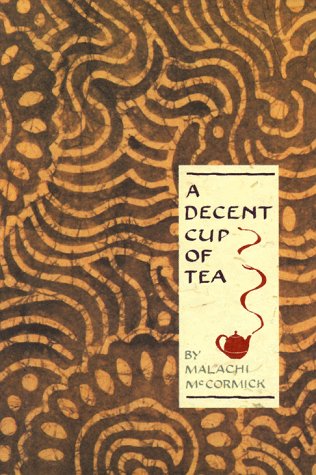
A Decent Cup of Tea
I remember finding the book while I was in college on one of our very regular Friday night jaunts to the Barnes & Noble near school. I bought a first copy as a gift, and on reading some of it before I bought it, had to buy a copy for myself. Then, as now, I loved the the handmade feel of the book and the irregularly cut pages. But the standout feature is the writing - easy to read, irreverent, and very human.
A Decent Cup of Tea was written for the same reasons I create dance workshops: in response to a pet peeve. McCormick was livid that even in London (at that time) you couldn't get a well-made cup of tea. He found the same in his native Ireland, and especially in the US after he moved here. This book was going to right that wrong.
The book was written before the rise in popularity of tea in this country - before there was a bubble tea fad, before everyone knew about the benefits of green tea, and before white tea was ever available outside of specialty stores. McCormick very deliberately sticks to black teas and gives a brief synopsis of their history and spread in popularity from east to west. He finishes his history chapter with the attempts to establish tea plants in the US, and effort that is still on-going.
The chapters go on through choosing a teapot, a few nice things to eat with tea, and the like, until we reach the climax: the RIGHT way to make tea. The chapter is 80% diatribe and 20% instruction, all sound, and no doubt convincing.
Although I am not nearly as vehement about my tea, I happen to agree with McCormick about the right way to drink tea, and certainly the right way to prepare it. It's for all of the reasons that he states that I gave up drinking dining hall tea in college and switched to coffee. Tea became the beverage we drank at night, every night, in the dorm, where we could be sure to prepare it the right way.
A few passages stood out in particular as I read last night:
- In advocating for loose leaf tea, McCormick says, "Tea bag tea is safe tea. Make mine loose."
- He says that afternoon tea should be more of a social occasion than a meal. Lighter fare is appropriate so it doesn't overpower the flavor of the tea.
- Tea is something we do with and for our friends.
- In another jab at tea bags: "If we use tea bags, can we be said to have a future?"
I discovered that Harney & Sons, purveyor of fine teas, have a Malachi McCormick blend called Decent Tea. Now I want to try it.
Next Week: something seasonal before the autumn gets away from us - Holiday Pumpkins!
10/29/2014
The Cheese Course
This week I read a book by Janet Fletcher from 2000: The Cheese Course.
Ever since Tria opened in Philadelphia, with it's long cheese menu, and artful presentations, I've been looking for the book that would tell me what to serve cheese with. At Tria, cheese selections always come with the perfect pairing of honey, or figs, or walnuts, or something like that. But most of the books out there, in my very limited search, seem to concentrate on what wines to drink with cheese. I wanted to know about food pairings, and I hoped that the Cheese Course would tell me everything.
The introductory chapter of the book is chock-full of information about cheese: what to look for in the shop, how to serve it, how to store it (plastic wrap is a no-no), etc. Before getting into specific recipes, Fletcher offers some general advice about assembling cheese platters - how to intentionally feature one kind of cheese, and what assortments might work best.
Fletcher advocates for having the cheese course at the end of the meal rather than before it. She says that when you serve cheese as an appetizer, guests tend to eat too much, which ruins their dinner. But cheese as a last course offers a way to lengthen the meal, to re-open conversation, and allow people to linger a little bit longer over a communal food. (I'll say in support of this theory that the one time I had a cheese course at the end of the meal, it was extremely well-received!)
One piece of information in this chapter has stayed with me, and has partially answered the question of why I find wine pairings, but not food pairings for cheese: if you are planning a food accompaniment to your cheese, wine is often not the best beverage to serve, especially if you are featuring fruit. The flavors of fruit and wine may compete with rather than complement each other. Fletcher than offers other beverage suggestions, including dessert wines, or even beer, that may work well with your cheese and other food selections. The key take-away for me was wine or food, but maybe not both.
The recipe chapters were divided by milk source: cow, goat, sheep and mixed. Rather than a cheese with one food pairing, the recipes were mainly salads with a featured cheese, or a baked bread or pastry with cheese. Several cheeses were served with dried fruit reconstituted with brandy or other alcohol.
The image above shows sheep's cheese with oven-dried tomatoes and roasted almonds. I definitely want to try a particular kind of French sheep cheese with cherry preserves.
The answer, of course, to my question and search for the definitive set of rules about what foods go with which cheese is that there are no rules. Tastes differ, and the only way to figure out what works is to try everything and see what works for you.
If you are a cheese fan, check out Janet Fletcher's website, which contains information about all of her books, recipes, listings of cheese classes, and links to her reviews of cheeses in the San Francisco Chronicle.
What are your favorite kinds of cheese, and what do you eat them with?
Next week, one of the first tea books I ever owned, A Decent Cup of Tea by Malachi McCormick.
Ever since Tria opened in Philadelphia, with it's long cheese menu, and artful presentations, I've been looking for the book that would tell me what to serve cheese with. At Tria, cheese selections always come with the perfect pairing of honey, or figs, or walnuts, or something like that. But most of the books out there, in my very limited search, seem to concentrate on what wines to drink with cheese. I wanted to know about food pairings, and I hoped that the Cheese Course would tell me everything.
The introductory chapter of the book is chock-full of information about cheese: what to look for in the shop, how to serve it, how to store it (plastic wrap is a no-no), etc. Before getting into specific recipes, Fletcher offers some general advice about assembling cheese platters - how to intentionally feature one kind of cheese, and what assortments might work best.
Fletcher advocates for having the cheese course at the end of the meal rather than before it. She says that when you serve cheese as an appetizer, guests tend to eat too much, which ruins their dinner. But cheese as a last course offers a way to lengthen the meal, to re-open conversation, and allow people to linger a little bit longer over a communal food. (I'll say in support of this theory that the one time I had a cheese course at the end of the meal, it was extremely well-received!)
One piece of information in this chapter has stayed with me, and has partially answered the question of why I find wine pairings, but not food pairings for cheese: if you are planning a food accompaniment to your cheese, wine is often not the best beverage to serve, especially if you are featuring fruit. The flavors of fruit and wine may compete with rather than complement each other. Fletcher than offers other beverage suggestions, including dessert wines, or even beer, that may work well with your cheese and other food selections. The key take-away for me was wine or food, but maybe not both.
The recipe chapters were divided by milk source: cow, goat, sheep and mixed. Rather than a cheese with one food pairing, the recipes were mainly salads with a featured cheese, or a baked bread or pastry with cheese. Several cheeses were served with dried fruit reconstituted with brandy or other alcohol.
The image above shows sheep's cheese with oven-dried tomatoes and roasted almonds. I definitely want to try a particular kind of French sheep cheese with cherry preserves.
The answer, of course, to my question and search for the definitive set of rules about what foods go with which cheese is that there are no rules. Tastes differ, and the only way to figure out what works is to try everything and see what works for you.
If you are a cheese fan, check out Janet Fletcher's website, which contains information about all of her books, recipes, listings of cheese classes, and links to her reviews of cheeses in the San Francisco Chronicle.
What are your favorite kinds of cheese, and what do you eat them with?
Next week, one of the first tea books I ever owned, A Decent Cup of Tea by Malachi McCormick.
Subscribe to:
Posts (Atom)