11/25/2014

A Proper Tea...

This week's book, A Proper Tea by Joanna Isles, is another early addition to my tea book collection.  It was published in the UK in 1987.  I bought it some time in the early 90s.


A Proper Tea is one of my favorite kinds of books about tea.  It opens with some basics about the history and the proper preparation of tea, like many tea books do, but the heart of the book are the chapters devoted to different types of tea occasion, the perfect tea for that occasion, and accompanying recipes.  Each chapter is illustrated by the author, using real china patterns as a basis for the watercolors.

Tea Outing
Two of my favorite teas, Darjeeling and Yunnan, are paired with A Proper Tea and Tea by the Fire.  Another appealing pairing is Keemun tea for a Black & White Tea. 

A Proper Tea
The most memorable chapter is called A Bizarre Tea, inspired by the 1920s tea and china sets designed by Clarice Cliff in bold shapes and colors.  The recipes in this chapter include orange-flavored sweets to echo the art deco designs.

Clarice Cliff's Bizarre Ware

The Black & White Tea chapter is an attempt to promote the tea party to a contemporary audience.  The recipes feature caviar-filled treats, all based around a sophisticated, minimalist color palette.  The author was writing at a time when tea had fallen in popularity compared to coffee and other beverages, even in the UK.  The author hoped that by showing a modern tea party example, she would convince readers that tea time and the tea party was not helplessly old-fashioned, but adaptable to current styles and habits, and well worth reviving.

Twenty-seven years later, tea and the tea party still survives.  Is teatime still a daily ritual in the UK?  It never was here in the US, which may or may not be related to the Boston Tea Party.  In my little piece of the world, having a tea party, going out to tea, or even a solo cup of tea at the end of the work day is still a moment of calm, a treasure in the middle of a hectic life.  I wonder if I would feel that way if it was just part of the daily pattern...

Next week:  A Proper Breakfast

11/19/2014

Holiday Pumpkins & Halloween Treats

This week, two reviews (to make up for my missed week)!

If you meet me, it will probably not take you long to learn the following:
  • I hate the color orange
  • I hate pumpkin pie spices
  • I adore autumn and all of its decorating possibilities
I always look forward to buying pumpkins and re-decorating my mantel and living room for fall.  I love the idea of cooking warm, hearty foods suitable for cold days.  I try to never be thwarted by the fact that my good china never quite matches my Thanksgiving table decor.  I always want to be in charge of Thanksgiving table decor.  I have many Halloween candle holders.

Mom's apartment - 2009?  2010?
Given this love-hate relationship, I find it a bit odd that I own not one, but two books that feature all things pumpkin-related.  This week we look at two books published in 1998:  Holiday Pumpkins and Halloween Treats.


Holiday Pumpkins, by Georgiane Brennan and Jennifer Barry begins with a chapter about pumpkin basics:  which pumpkins are best to eat, how to grow and store pumpkins, how to cook and purée pumpkin, and how to prepare pumpkin blossoms (hint:  watch out for hidden bugs).   The authors say that pumpkin adds needed moisture to baked goods, and can take on the flavours of most things it's cooked with.

The chapters alternate between pumpkin recipes and pumpkin crafts and decor.  Most of the savory recipes sound tasty:  honey grilled pumpkin slices, pumpkin pomegranate beef stew, etc.  After I bought the book way back when, I was determined to make pumpkin pasta with baby bok choi and prosciutto only to be defeated when I couldn't find pre-made pumpkin pasta.  Someday I will try to make pasta at home, but it always sounds like a huge amount of work.  Maybe pumpkin pasta is worth it...

The vast majority of pumpkin desserts are not for me.  Inevitably, pumpkin desserts, except for some versions of pumpkin pie, ironically enough, contain cloves, nutmeg, allspice, etc., all spices I hate (it's a family trait).  These recipes are easy enough to skip.  And though I like the crafts and decor chapters telling me how to make candle holders out of mini pumpkins and soup bowls out of medium pumpkins, it turns out I have glass pumpkin candle holders, ceramic pumpkin soup bowls, pumpkin-shaped salt and pepper shakers, and on and on.  I'm all set.

I love how this book is more about autumn than Halloween.  The recipes seem warm and hearty, and within my skillset.  Maybe next year is the year of pumpkin pasta.  Who's in?

Halloween Treats by Donata Maggipinto, though it has some recipes for alcoholic drinks, is really aimed at family activities and cooking projects.  It also combines crafts and recipes, but I found it disconcerting that the chapters randomly combined food and non-food projects, so that I was almost surprised to be reading about paper mâché Halloween treat bowls right after a bat-shaped sugar cookie recipe.  I like the format of alternating chapters better, to keep my brain organized.  The book also doesn't always have the picture of a dish or item near the recipe or instructions.  Sometimes I found myself guessing at what I was looking at.

Some treats I would like to try someday include rolled marshmallows stamped with a mini ghost cookie cutters, warm red cabbage slaw with apples, and an entire dinner of only orange and black food.  I attended an orange and black dinner once and it was great fun!

What are your favorite pumpkin recipes?  How do you decorate for autumn?

Next week:  A Proper Tea

11/04/2014

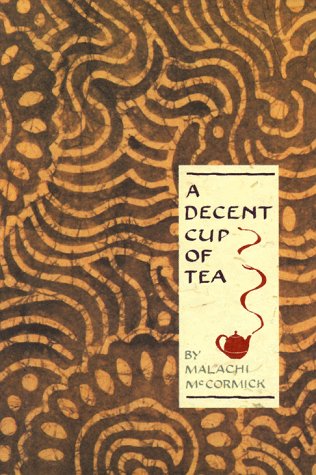
A Decent Cup of Tea

Last night I re-read after many years Malachi McCormick's slim volume from 1991, A Decent Cup of Tea.


I remember finding the book while I was in college on one of our very regular Friday night jaunts to the Barnes & Noble near school.  I bought a first copy as a gift, and on reading some of it before I bought it, had to buy a copy for myself.  Then, as now, I loved the the handmade feel of the book and the irregularly cut pages.  But the standout feature is the writing - easy to read, irreverent, and very human.

A Decent Cup of Tea was written for the same reasons I create dance workshops:  in response to a pet peeve.  McCormick was livid that even in London (at that time) you couldn't get a well-made cup of tea.  He found the same in his native Ireland, and especially in the US after he moved here.  This book was going to right that wrong.

The book was written before the rise in popularity of tea in this country - before there was a bubble tea fad, before everyone knew about the benefits of green tea, and before white tea was ever available outside of specialty stores.  McCormick very deliberately sticks to black teas and gives a brief synopsis of their history and spread in popularity from east to west.  He finishes his history chapter with the attempts to establish tea plants in the US, and effort that is still on-going.

The chapters go on through choosing a teapot, a few nice things to eat with tea, and the like, until we reach the climax:  the RIGHT way to make tea.  The chapter is 80% diatribe and 20% instruction, all sound, and no doubt convincing.

Although I am not nearly as vehement about my tea, I happen to agree with McCormick about the right way to drink tea, and certainly the right way to prepare it.  It's for all of the reasons that he states that I gave up drinking dining hall tea in college and switched to coffee.  Tea became the beverage we drank at night, every night, in the dorm, where we could be sure to prepare it the right way.

A few passages stood out in particular as I read last night:
  • In advocating for loose leaf tea, McCormick says, "Tea bag tea is safe tea.  Make mine loose."
  • He says that afternoon tea should be more of a social occasion than a meal.  Lighter fare is appropriate so it doesn't overpower the flavor of the tea.
  • Tea is something we do with and for our friends.
  • In another jab at tea bags:  "If we use tea bags, can we be said to have a future?"
 McCormick's final chapter is about reading tea leaves, something else I did quite a bit of in college, using this book and another as a guide.  He reminds us that tea leaf readings should be in response to questions or concerns, with the reader providing a frame and the beginning of the conversation.  It's the participatory nature of tea leaf readings that make them so much fun.

I discovered that Harney & Sons, purveyor of fine teas, have a Malachi McCormick blend called Decent Tea.  Now I want to try it.


 Next Week:  something seasonal before the autumn gets away from us - Holiday Pumpkins!

10/29/2014

The Cheese Course

This week I read a book by Janet Fletcher from 2000:  The Cheese Course.


Ever since Tria opened in Philadelphia, with it's long cheese menu, and artful presentations, I've been looking for the book that would tell me what to serve cheese with.  At Tria, cheese selections always come with the perfect pairing of honey, or figs, or walnuts, or something like that.  But most of the books out there, in my very limited search, seem to concentrate on what wines to drink with cheese.  I wanted to know about food pairings, and I hoped that the Cheese Course would tell me everything.

The introductory chapter of the book is chock-full of information about cheese:  what to look for in the shop, how to serve it, how to store it (plastic wrap is a no-no), etc.  Before getting into specific recipes, Fletcher offers some general advice about assembling cheese platters - how to intentionally feature one kind of cheese, and what assortments might work best. 

Fletcher advocates for having the cheese course at the end of the meal rather than before it.  She says that when you serve cheese as an appetizer, guests tend to eat too much, which ruins their dinner.  But cheese as a last course offers a way to lengthen the meal, to re-open conversation, and allow people to linger a little bit longer over a communal food.  (I'll say in support of this theory that the one time I had a cheese course at the end of the meal, it was extremely well-received!)

One piece of information in this chapter has stayed with me, and has partially answered the question of why I find wine pairings, but not food pairings for cheese:  if you are planning a food accompaniment to your cheese, wine is often not the best beverage to serve, especially if you are featuring fruit.  The flavors of fruit and wine may compete with rather than complement each other.  Fletcher than offers other beverage suggestions, including dessert wines, or even beer, that may work well with your cheese and other food selections.  The key take-away for me was wine or food, but maybe not both.

The recipe chapters were divided by milk source:  cow, goat, sheep and mixed.  Rather than a cheese with one food pairing, the recipes were mainly salads with a featured cheese, or a baked bread or pastry with cheese.  Several cheeses were served with dried fruit reconstituted with brandy or other alcohol.


The image above shows sheep's cheese with oven-dried tomatoes and roasted almonds.  I definitely want to try a particular kind of French sheep cheese with cherry preserves. 

The answer, of course, to my question and search for the definitive set of rules about what foods go with which cheese is that there are no rules.  Tastes differ, and the only way to figure out what works is to try everything and see what works for you.

If you are a cheese fan, check out Janet Fletcher's website, which contains information about all of her books, recipes, listings of cheese classes, and links to her reviews of cheeses in the San Francisco Chronicle.

What are your favorite kinds of cheese, and what do you eat them with?

Next week, one of the first tea books I ever owned, A Decent Cup of Tea by Malachi McCormick.

10/21/2014

Tabletops

This week's book review and write-up are a bit out of sync this week because of travel in the middle, but moving on with our Books-from-the-Free-Library-Bookstore series, the other weekend I read Tabletops by Barbara Milo Orbach.


Orbach, author of many books on flowers, decorating, etc., fills her chapters with advice about what to put on the table, color schemes, flowers, and centerpieces.  She says, "The table is the center of life at home.  A beautifully set table is the ultimate symbol of hospitality and a way to express creativity." Each section includes a DIY project such as making napkin rings or floral arrangements.

This is a book from 1997.  And it shows.  The settings and table arrangements are lush, elegant and busy, unlike the simpler, more homemade aesthetic that prevails today.  I liked the book - not loved it - but to me it felt dated and a little quirky.  Here are some things I noticed and specifically noted:

  • There is actual text to read, not just pictures and captions
  • The text reads like the actual author might have written it
  • The author constantly refers back to other books she has written, and in fairness, to other author's books
  • A gauze ribbon tied around anything makes that thing better/fancier
  • Scented stuff always creeps in, despite the author's saying that it's better to avoid scented products at a dinner party because it interferes with the food
  • Although this professes to be a book about tabletops, it turns out to really be a book about flowers and making centerpieces with flowers, food, fruit, etc.  There is minimal information about setting the table, creating a balanced tabletop, and actually arranging the flowers.
  • Any table inside is formal.  Any table outside is informal.
I don't buy all of this stuff, but there were a couple of things I liked about the book in particular.  
  • The author emphasizes planning ahead and doesn't assume that you can create a beautiful table without trying things out and practicing first. 
  • She admits that she really likes setting the table, but cooking is not her thing.  
  • It made me think about a couple of things:  (1) The plates I always thought of as dessert plates in my sets of china are actually bread-and-butter plates, and (2) It's really past time to inventory and edit my china cabinets and think about what I already have that coordinates, or doesn't.
Next week:  The Cheese Course!  

10/07/2014

A Guide to Tea

 This weekend I had a chance to read one of the books I bought at the Free Library used bookstore last week.  I started with this one, A Guide to Tea.


Note there is no author's name on the front cover of the book. This should be the first clue of what's to be found inside...

A Guide to Tea, while pleasant enough, is really some kind of advertising/marketing piece for Adagio teas.  Not only does it not have an author until you get to the title page, there is no publisher, no photo credits, and no publication date, I suspect so it can't get out of date for as long as Adagio wants to sell it (which I don't think it's doing anymore...).  Amazon reports the date as 2005.  Apparently the author, Chris Cason, is a real person, and really a tea guy.  He may or may not be the tea sommelier for Tavalon Teas.

The book, though about 85 pages in length, is fairly low on content.  (In fairness, it doesn't pretend to be otherwise.)  It ranges across many topics from how to brew tea to where does tea come from to tisanes, but it goes into none of these areas in depth.  The writing is informational, with the unfortunate addition of unnecessary witticisms and/or colloquialisms that seem to be added as an afterthought.  Why?  Why the strange opening justifying the existence of the book because of the Boston Tea Party?


I enjoyed the fact that this book is not a recipe book, but really a book about tea.  Often tea books are just cookbooks with an opening chapter about tea types, etc., but this book stuck to the subject.  It includes many beautiful pictures, uncaptioned and uncredited, but supposedly of Asian and Indian tea plantations, workers, and tea in situ.  But the pictures seem unrelated to the chapter at hand, except in the most general sense. 

I'm happy to have this book, though it will never be a go-to reference guide.  I wonder what the impetus was to publish it to begin with, and whether it was considered to be a success.  Have you heard of it?  Have you read it?  What do you think?

Next week:  Tabletops by Barbara Milo Ohrbach

10/03/2014

A New Chapter...


Just when I come to the moment of admitting this blog should go away, I'm inspired to write something.  This week's inspiration is brought to you by the Free Library of Philadelphia, and more specifically, their used bookstore, which I happened to pass, and which happened to be open as I was walking across town the other evening on my way to the opera.  And you know what happens when you pass a used bookstore...

I came away with four books:

Consider the Fork
http://www.considerthefork.com/

Tabletops by Barbara Milo Ohrbach
http://www.amazon.com/Tabletops-Practical-Beautiful-Decorate-Table/dp/0517703327/ref=la_B001IO9I0U_1_2?s=books&ie=UTF8&qid=1412347455&sr=1-2


http://www.adagio.com/pages/book.html
http://www.janetfletcher.com/books.html

...none of which I already owned, which is a miracle!!

But these books got me to thinking about my preoccupation with the subject matter these all dance around, the blogs I read, and the blogs I look for and don't find, now that blogs are unfashionable.  And then there's my not-so-secret desire to give up the career-oriented job I have and open a tea shop and library of all of these books, plus the many, many more on my bookshelves.  And so the kernel of an idea for this blog was born - a weekly review of literature.  Well a sort of literature anyway.

A quick glance at my catalog of books revealed just over 200 books I want to talk about here.  The topics vary, but the vast majority are about tea and tea-related topics.  The next set focuses on aspects of entertaining including tablescapes, table setting, etc.  The smallest group is about home organization and decorating, including a topic near and dear to my heart, flower arranging - a skill I don't really have, but covet.

I'll start with the four shown above, as I read them and attempt to find a place for them to live.  Hopefully you'll read about a new book weekly, starting next Tuesday!